I’ve reached the apex of my trip and now start heading back to my starting point in Lisbon.
Today could set up to be the most boring of my trip. I’m starting this morning from my alberge in Finnesterre – which I need to vacate by 10 am. I then have a 2.5 hour bus ride to Santiago at 11:45, followed by a 3 hour layover before a second 3+ hour bus to Porto.
The alberge was comfortable and quiet last night and I got a great night’s sleep after a dinner of paelle, Padron peppers and wine.
While waiting for my bus, a man was wearing an Oregon Ducks t-shirt passed me. I stopped him and asked if he was from Oregon. He laughed and said he was from Australia. His son’s girlfriend had given the shirt to him and he had no idea what the Duck image represented – until he started meeting people from Oregon. “And they are all the nicest people.”
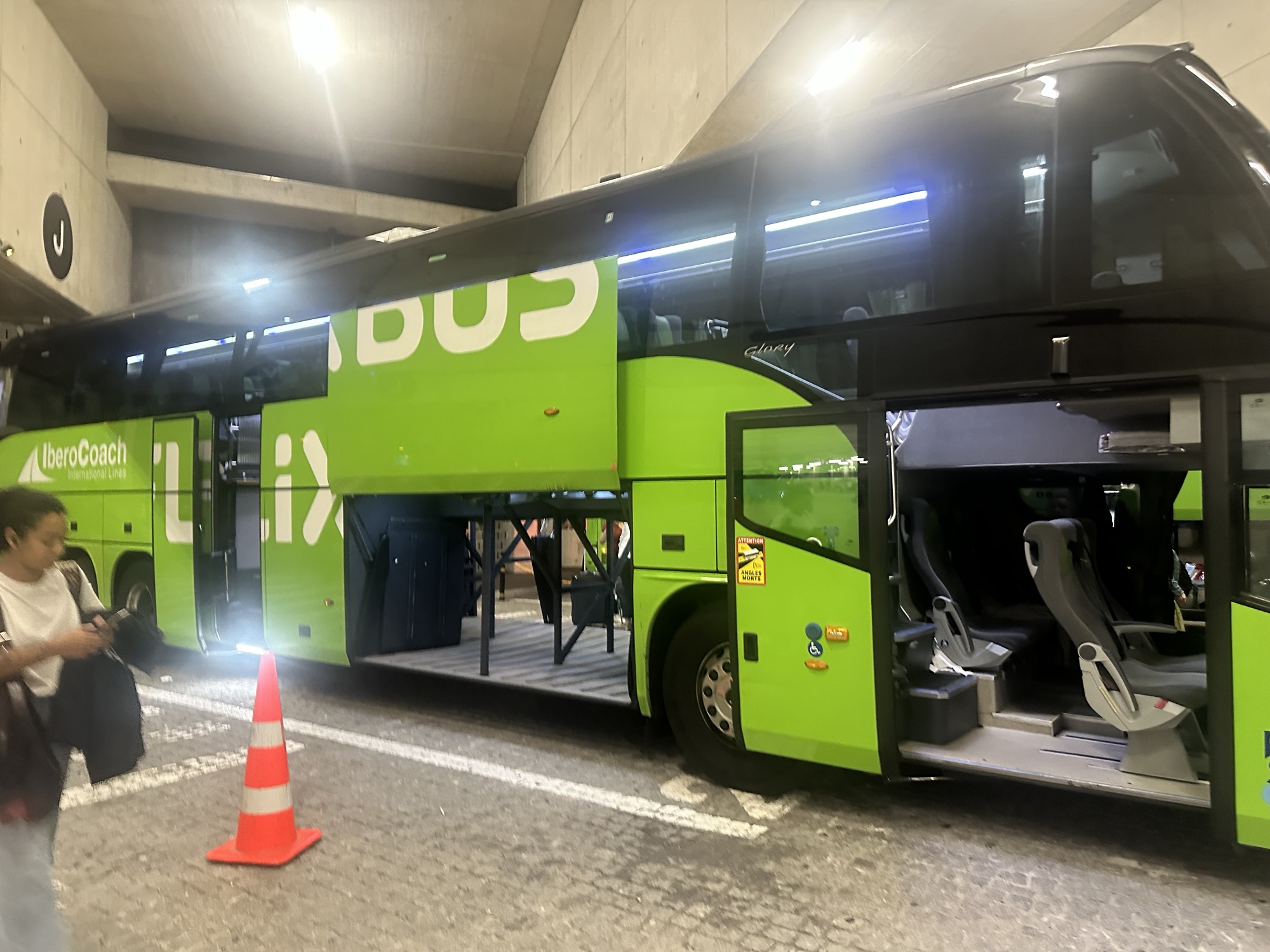
Our massive, double decker bus was more than 15 minutes late arriving and by the time they off-boarded and then got all the backpacks and people on, we were over 30 minutes behind schedule. All the through-passengers to Santiago were put the upper level, which gave us a nice view.
The bus was so large and the streets so narrow that we had to drive down to the commercial fishing docks to have enough room to negotiate a Y-turn. Those sitting in the front row up top got a straight down look into the water as the driver pulled forward as possible.
The second leg of the trip was surreal heading down the highway at 120kph. What had taken me two weeks to walk passed by in a couple of hours + stop times in Vigo and Braga.
I arrived at my hostel after dark and for the first time in 30 days, I was assigned an upper bunk. That’s what I get for getting here late! Hopefully tomorrow I can switch to a lower bunk when others move on.
Finisterre this morning. The hill in the background was what I climbed yesterday Same spot looking the other wayView of the city from the fishermen’s wharf.
I slept poorly last night. Chalk that up to consuming caffeinated beverages too late in the day. This eating meals much later is hard to adjust to.
After my four-night stint in a hotel room with a private bath, it’s time to get back to communal living.
I repacked my belongings and walked down the road to the intermodal station. A beautiful new complex designed to move lots of people into and out of the city by train & bus.
I arrived early and enjoyed a tarte de almande (almond cake) and a coffee in one of the two cafeterias in the complex. The platform for my bus to Finisterre has just been posted, so I’ll relinquish my seat and power port.
Our comfortable motor coach pulled out of the station at 10:01. As we went over the first hill, I realized the illusion of just hanging out in the historic quarter of a city. Santiago is a bustling city.
We headed out of the city and through various towns and villages. We took some corners that you had to feel were included in the calculations for how long the buses could be. Any longer and they would have not been able to negotiate.
While most of riders were pilgrims like me, the bus also serves as a commuter bus with locals hopping on and off every few kilometers.
I first spotted the coast near Muros and the last 30 minutes of the ride followed the coastline first to Cee and then along the peninsula that includes Finisterre.
The bus pulled into Finisterre and right across the street was a place called the Hippy Bar. I ventured in just as two German ladies at the adjacent table had a beautiful, huge salad delivered. I’ve been starved for vegetables, so that’s what I ordered.
When I finished lunch, there were still about 15 minutes to kill before the alberge opened at 2. I decided to go get in line so as to improve my chances of not getting an upper bunk.
I was the fifth person to arrive. We started introducing ourselves and I learned that one woman was from the Czech Republic, one guy was from The Netherlands and the other two young women were from Seattle and Portland!
This is a nice alberge with bunks for 32. I’m in a pod of 4 bunks and currently only the bottom four beds are occupied.
Maddie, the girl from Seattle, stopped by and said she was going to hike out to the lighthouse and asked if I wanted to come along. We took a trail along the Atlantic side of the peninsula and it ended up going to the top of a 740 foot hill. From the top, we could see the lighthouse below another few hundred meters.
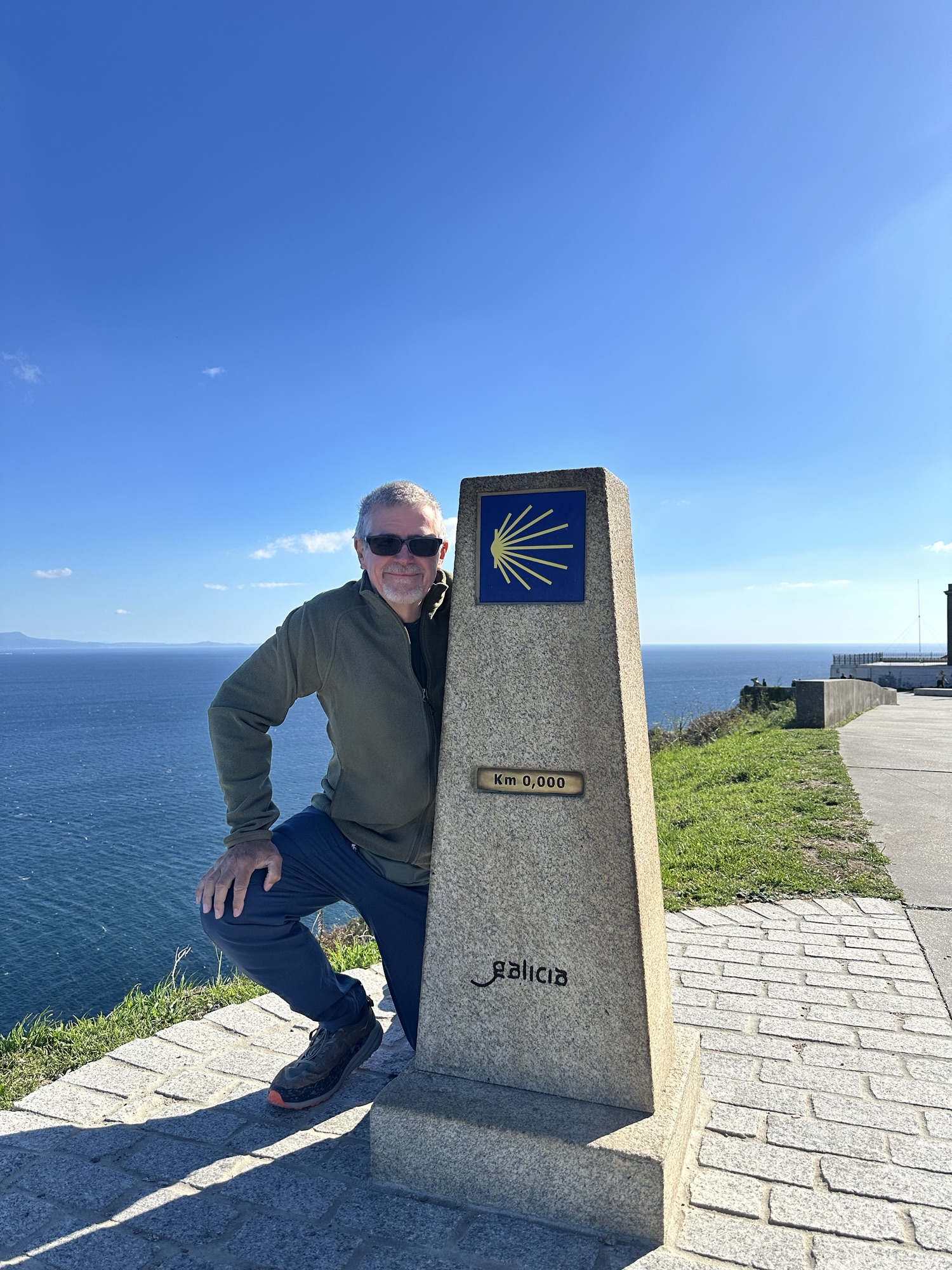
We went down the hill to the lighthouse, had a drink, took photos at the 0.00 kilometer Camino marker and then I threw my stone into the sea.
Fishing boats near CeeOur bus pulling awayI have been craving vegetables. This salad helped. At its narrowest point, the peninsula is only a couple hundred meters across. See the water beyond the hill. Lighthouse from the summit of the hillMile marker 0.00Lighthouse up closeShirley’s stone before I tossed it off the cliffI think somebody was done with their bootsStatue in the local chapel. Mary and Jesus looking out for the fishermen
I started my morning by finalizing the remainder of my time on the Iberian Peninsula. I had previously scheduled an overnight trip to Finistere starting tomorrow and then back to Porto on Friday.
My parents generously gifted me a day trip up the Douro Valley, so I booked that for Saturday along with another night in the hostel in Porto.
I now have train tickets back to Lisbon and a hostel in the historic city center for Sunday & Monday nights. I’ll then move to an airport-adjacent hotel Tuesday in preparation for my early Wednesday flight home.
Santiago is by far the most expensive place on this trip. It’s fairly easy to blow 70-80 Euro a day on meals and drinks. I was getting beer or wine in the countryside for €2. It’s €5.50 here. Dinner entrees that are under 10 elsewhere are closer to 20 and more.
Since I’m on my own today, I’m going to try and go frugal. I’m starting my day at Cafe Paradiso, which was listed in Trip Advisor as one of the best cheap places to eat. That said, my Spanish tortilla was still €8. But it was hearty and tasty and will hold me for many hours.
After breakfast, I decided to walk over to the Pilgrim Office and see about getting a Compostela. I had heard that rules changed this year and any 100km segment of a Camino qualified you for the certificate.
When my number was called, a volunteer from the UK greeted me. She asked when and where I started, and I told her Lisbon on September 11. She said, “oh, you walked 630 kilometers.” Had I kept my mouth shut I would have been issued the certificate, but I said, “no, I injured myself and stopped walking at Redondela.” It was her first day working, so she summoned a supervisor who asked me if I had walked into Santiago. When I said “from the train station,” she shook her head and said that didn’t qualify.
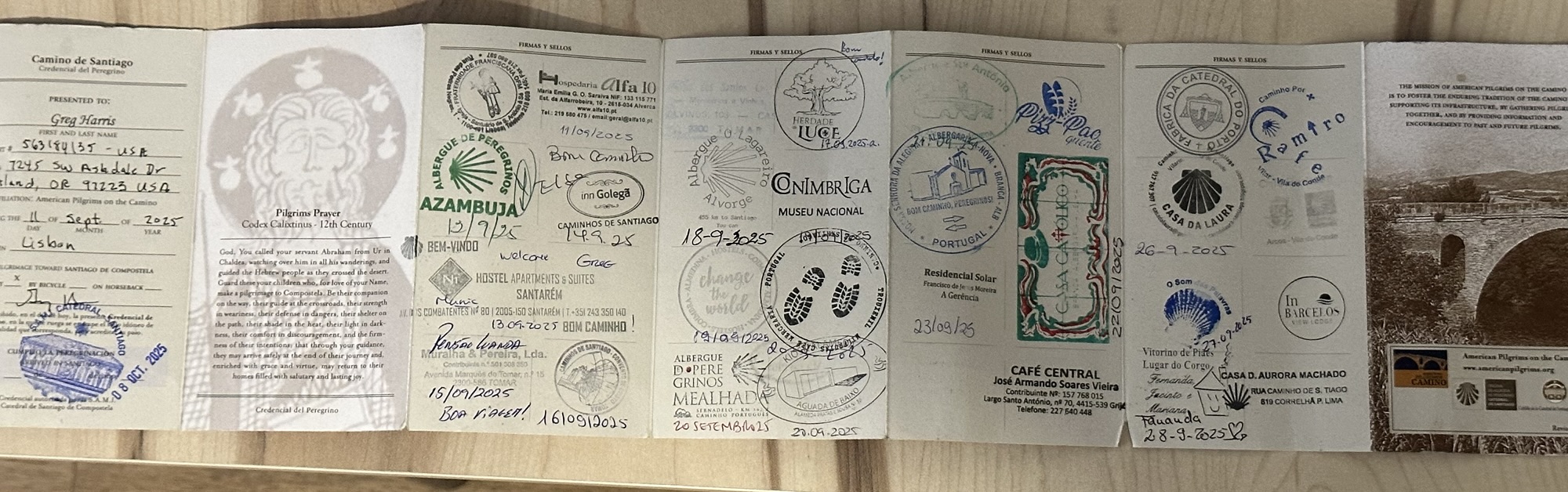
I was issued a certificate showing that I had visited Santiago and the cathedral. No worries, for me the most important document is my Pilgrim Passport with all the places I’ve visited on this journey.
I learned that Ruth & Thea, the mother/daughter duo from Vancouver BC were still in town and we got together for one final dinner. Ruth found a really authentic place with a pilgrim menu (starter, entree, bread, dessert & wine or beer) for a fixed price of €14. They had several options for each course, so we decided to each order something different and then eat family still. Our feast included roasted Padron peppers, muscles, green salad, paella, grilled squid, an omelette, almond cake, flan & rice pudding.
A tortilla in Spain is like an omelette with chunks of potatoes added to make it hardy Back side of my pilgrim credential with stamps from various places visited Front side. My certificate of visitation I spotted this very interesting looking building on a hill. Turns out to be the City of Culture of Galicia. Their website says nearly every window is a different shape. My leg injury has put a damper on my daily steps. Apple Health was nagging me this morning
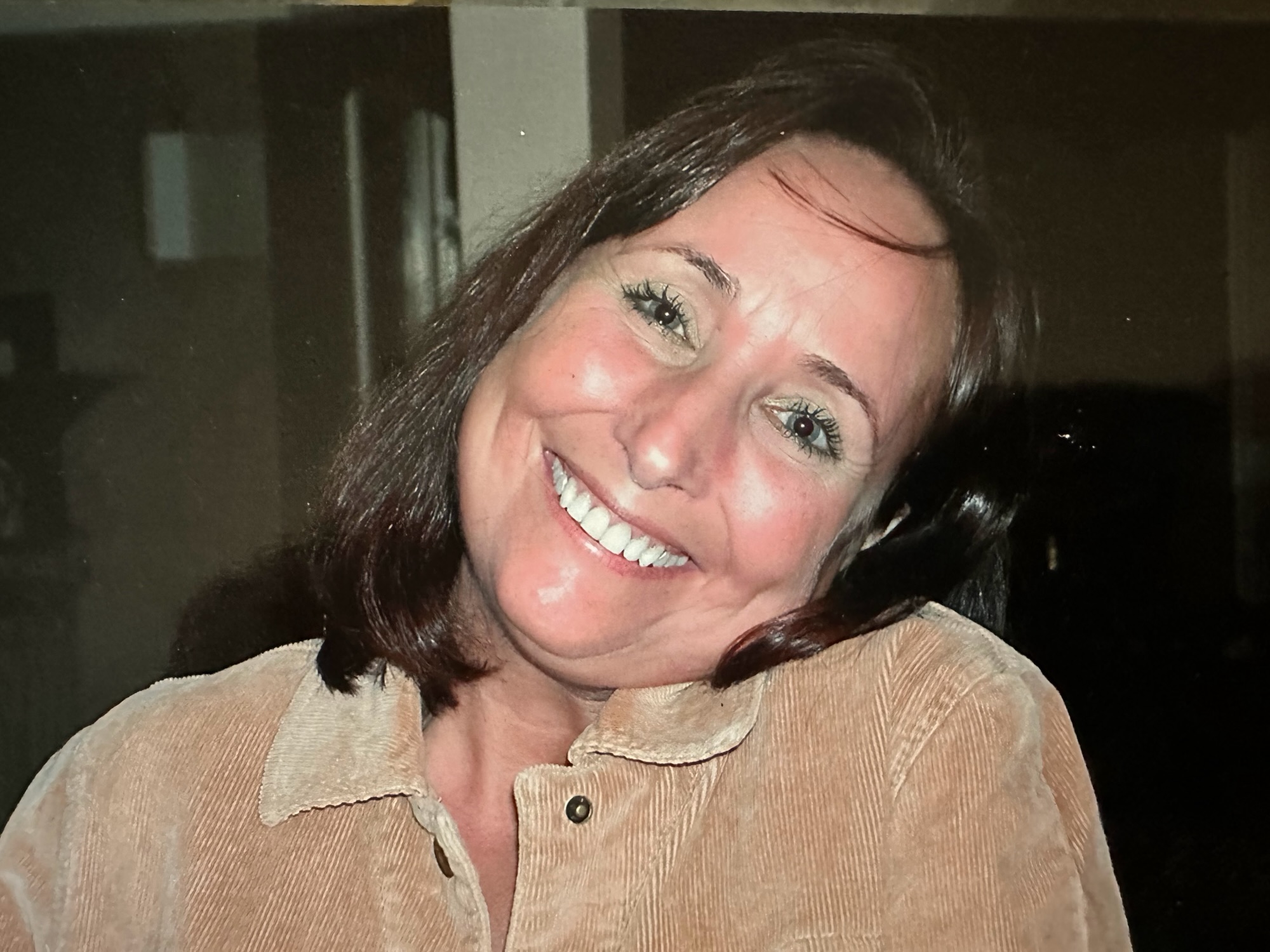
Today marks the one year anniversary of the passing of Shirley Hauge – my partner for over 19 years and wife for 310 days.
Shirley was a fighter. She could be (very) stubborn and set in her ways. When told in her early 30’s that she had a genetic lung disease and had about 5 years to live, she would have none of that and lived another 30+ years.
When told she qualified for a lung transplant, but would need to improve her strength, she joined a gym and began swimming. Mind you, she was on oxygen at the time, so this meant me or one of the kids would go with her and walk a portable tank back and forth while she slowly swam a mile of laps. We called this walking the fish.
The three things that brought Shirley the most joy in life were kids, animals and entertaining.
Once she discovered her genetic condition she decided not to have any siblings for her daughter, Jessica. But she embraced my kids as if they were her own, was a generous and loving aunt to 20 nieces & nephews and always kept a toy box in the living room for any child who visited.
Once we became empty nesters, she began being a second mom to international students attended Valley Catholic High School. We hosted numerous kids from Japan, China, South Korea and Thailand. Two of them lived with us for multiple years and I will always look at them as my bonus daughters (now living in LA and NYC).
Shirley loved animals of all kinds. We always had multiple pets in the house – and of course they all slept in bed with us. As a kid she had horses and ponies and was a successful competitive horse jumper. She was notorious for giving food to pets when we visited friends – even if their owners would prefer she she not (see above for stubborn streak).
She was an animal whisper and could coax wildlife to her. Deer, birds and squirrels would come right up to her. I remember a trip to Central Oregon when she sat down and squirrels crawled right into her lap.
Entertaining and cooking for a crowd was what brought the most pleasure to Shirley. She didn’t know how to cook for less than 8 or 10. I attribute that to growing up in a big family.
Her annual Christmas party was an epic event. At its peak, we’d have 150-200 guests and Shirley would prepare dinner for everyone. By the time I came around, the party had been an annual ritual for over 20 years and it had tamed down a bit and the house would be clear by 2 or 3 am. But I heard stories about the early years when breakfast the next day was served to the stragglers.
When Shirley got her lung transplant in 2013, we had hoped that it would usher in a period of more energy and the ability to do more active things. But a postoperative infection nearly killed her and kept her hospitalized for six months. She never fully recovered from that but her stubborn determination kept her going.
Aside from the infection in 2013, her last 12 months were the most challenging. In late 2023, we took our second trip to SE Asia. This time to attend the wedding of our bonus daughter, Joy. But Shirley got Covid and by day 5 of our month-long trip, she was in an ICU in Cambodia.
After our return home, she began having issues with both her heart and kidneys. It seemed that medication necessary for one had negative consequences for the other. She was hospitalized 12 times in 2024, each lasting 5-9 days.
With her health conditions, we always realized that barring a sudden accident I would outlive Shirley. Talking about death isn’t easy, but we were able to have long conversations on the subject. Shirley recognized that her physical limitations put a damper and things that I liked to do. She encouraged me to rediscover these activities after she passed away.
My Camino journey is in part to commemorate Shirley and to rediscover activities I had put aside while partnering with someone unable to take them on.
A Camino ritual is to leave a stone along the trail, symbolizing removal of a burden carried through life. Since I left home, I’ve been carrying a stone that was given to Shirley that has the word “strength” inscribed on it. Shirley was the eptiome of strength. And in her honor I will cast that stone into the water at Finistere.
Cookie Consent
We use cookies to improve your experience on our site. By using our site, you consent to cookies.
Contains information related to marketing campaigns of the user. These are shared with Google AdWords / Google Ads when the Google Ads and Google Analytics accounts are linked together.
90 days
__utma
ID used to identify users and sessions
2 years after last activity
__utmt
Used to monitor number of Google Analytics server requests
10 minutes
__utmb
Used to distinguish new sessions and visits. This cookie is set when the GA.js javascript library is loaded and there is no existing __utmb cookie. The cookie is updated every time data is sent to the Google Analytics server.
30 minutes after last activity
__utmc
Used only with old Urchin versions of Google Analytics and not with GA.js. Was used to distinguish between new sessions and visits at the end of a session.
End of session (browser)
__utmz
Contains information about the traffic source or campaign that directed user to the website. The cookie is set when the GA.js javascript is loaded and updated when data is sent to the Google Anaytics server
6 months after last activity
__utmv
Contains custom information set by the web developer via the _setCustomVar method in Google Analytics. This cookie is updated every time new data is sent to the Google Analytics server.
2 years after last activity
__utmx
Used to determine whether a user is included in an A / B or Multivariate test.
18 months
_ga
ID used to identify users
2 years
_gali
Used by Google Analytics to determine which links on a page are being clicked
30 seconds
_ga_
ID used to identify users
2 years
_gid
ID used to identify users for 24 hours after last activity
24 hours
_gat
Used to monitor number of Google Analytics server requests when using Google Tag Manager