Another quiet night in the bunk room. Tonight I had an upper bunk companion, but she did make a sound. I only knew it was a woman by the shoes at the bottom of the ladder.
After breakfast, I packed up and secured my stuff in a locker on the hostel lobby. I have over for hours to kill before reservations at the Lisbon Aquarium, which is on the metro line to the airport and my hotel for the night.
It’s a beautiful day, so I just started walking. I soon found myself at the waterfront watching the ferries cross between Lisbon and the cities on the other side of the Sea of Straw.
Sitting there, I remembered that I had yet to successfully locate a Geocache on this adventure. I had tried in Porto and Finistere, but both efforts were stymied by long descriptions in the local language that I was unable to copy & paste into Google Translate. With some time on my hands, I thought I’d give it another go.
To my delight, there was one less than 100 meters from me with a description in English. After a quick success, I thought I’d try another. The second was even easier and provided me with some history about one of the few buildings to survive the 1755 Quake. This one dating to 1585.
On my way to a third cache, I stopped at the Pastelaria where I had my dessert last night. Time for an almond croissant and an espresso.
After four easy finds I decided to try and hop on another trolley. My map showed an intersecting line seven blocks north, so I headed in that direction. Only to discover that the distance included a significant elevation change. The path to the upper elevation was a finicular track. The finiculars are currently not running as they all undergo safety inspections following the deadly accident on September 3 that killed 16 people.
I reached the top and waited at the nearby tram stop, but when it arrived, it was packed tighter than a can of Portuguese sardines. Checking my watch, it was late enough that I decided to walk back to my hostel, claim my bag and grab a Metro to the Aquarium, where I had tickets for a 2pm entry.
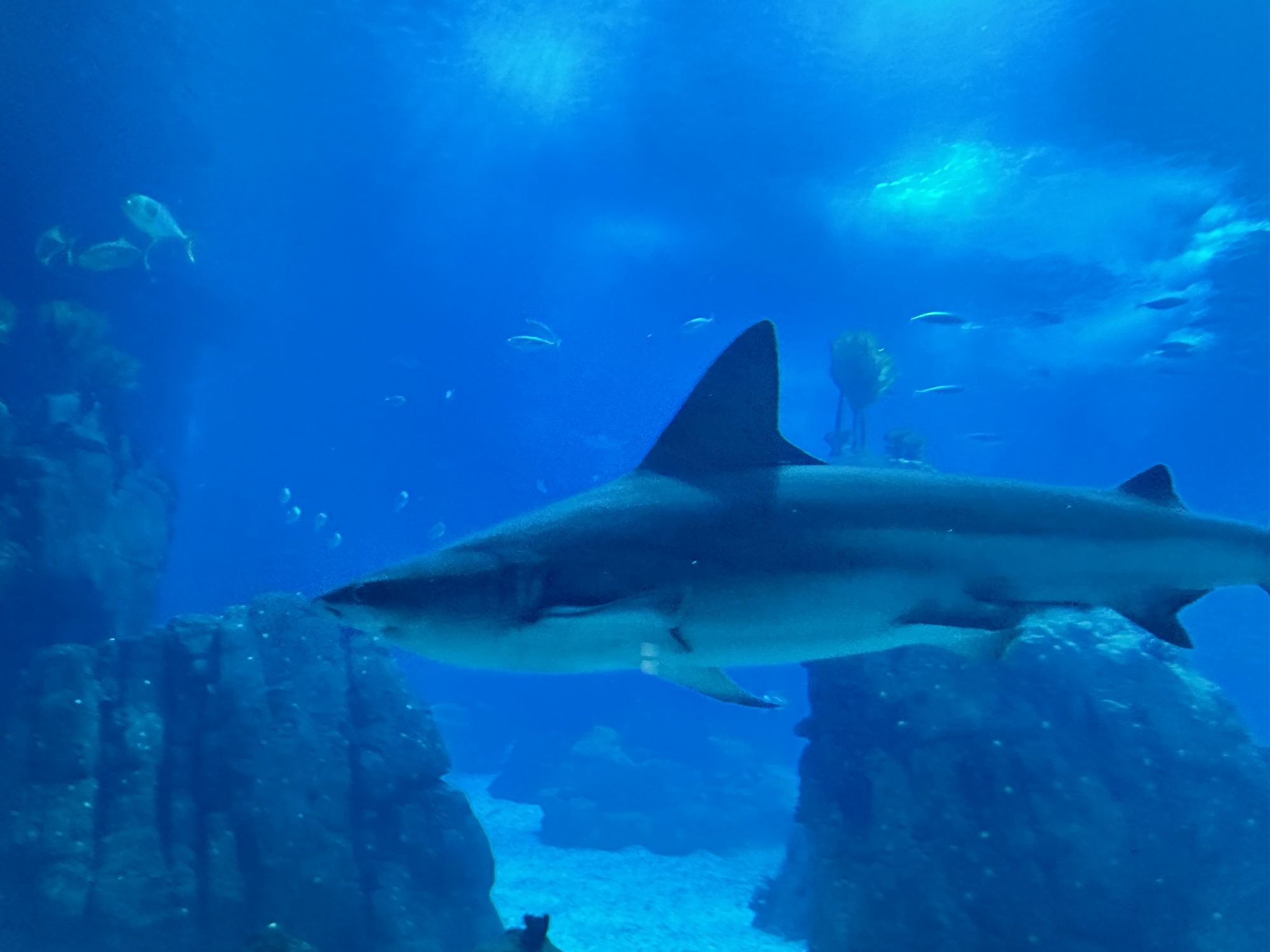
The Aquarium was amazing. It had a giant central tank and the outer perimeter was divided into four sections each representing a different oceanic area. The walkway around was on two levels, so you could see shoreline inhabitants on the upper level (puffins, penguins, sea otters, etc) and sea life on the lower level. I’ll let the photos speak for themselves.
I spent nearly three hours at the Aquarium and then took the Metro three more stops to the airport. My room for the night was less than a kilometer walk away.
Proof I was here This tiled square is perfectly flat, but give the illusion of an uneven surface Elevator designed by Eifel’s student My first geocache find in Portugal One of the few buildings to survive the 1755 quakeJust a reminder that you are near a fault line Looking down the finicular trackAmbassador to the southern oceans exhibit JellyfishSeastar and anenomiesThe sunfish is my nominee for weirdest looking fish The Indian Ocean exhibit included a rainforest trail. Jellyfish AnenomeSwimming penguin Fish seemed to be more colorful in the Indian Icean
I may have generalized the differences between hostel and Alberge too much.
I’m now staying in a hostel called The Central House and I couldn’t be more pleased. While I’m staying in another mixed bunk room, there are only six beds and they are arranged to add privacy.
This panoramic shot shows the bed arrangement. One bunk plus storage lockers to the left. I’m standing in front of the bathroom, to the right of the door. The other two sets of bunks are on each side of a privacy wall. My bunk is down the lighted hallway beside the window.
I’m not even sure how many beds were occupied last night. The bunk above me was empty and there are at least two others here, but they were so quiet and considerate.
While we share a bathroom, it’s located inside our room and we even have an electronic door lock. And for the first time since getting to Europe, there is an elevator to reach my 5th floor room!
My bunk pod is by the window, which has a small balcony looking down to the street below. With my earplugs, the city noise was not an issue.
After my morning routine, I went downstairs to a really nice breakfast buffet included with my room. I was out the door by 8:10 and the first to arrive at the laundromat one block away. With a little luck, I’ll be done with my domestic chores before most tourists are out and about.
My first mission of the day is to ride the infamous #28 trolley, which is typically picked with riders. I’m hoping an early start will let me get a jump on most folks.
I was able to get on the first trolley passing by. I had to stand for one stop, but then a seat opened up and I had a grand view of the narrow streets and beautiful views.
Trolly ride video through the narrows streets
While riding the trolley, I remembered seeing a billboard yesterday for an Earthquake Museum. I located it several miles from my current location. Hoping off the trolley as we passed a Metro station, I took the subway back to city center and then a light rail train towards the city of Belem.
The Quake museum was fantastic. Those who know me are aware of my interest in emergency preparedness, and this museum did not disappoint. It’s quite new and has a variety of interactive exhibits.
The highlight is a 4D reinactment of the the November 1, 1755 quake while sitting in Mass. The full-wall CG animation starts as the acolytes come in and light the candles. About 3 minutes into the service, your seat make a violent jerk. You end up “riding” your pew seat for a few minutes as you see the candles start the drapes on fire, candelabras crash to the floor and eventually, the entire alter in front caves in, leaving you with a view of the devastation beyond.
I’ve cut to just before things start to get really bumpy. Be sure to have the sound on.
As you leave the cathedral simulator, the next room provides information about the fires that devastated the city. You read, listen and watch while infrared lights make you feel the heat.
Learning about the rebuild of Lisbon is another truly remarkable tale. It essentially gave root to the disciple of urban planning.
Heading back into Lisbon, I knew I would be riding through the neighborhood I stayed in last month. I wanted to see if I could find the restaurant where I had the hot rock steak. I was pleased with how familiar the area looked and I was able to walk right back to the restaurant and get the name so I can find it tonight in the dark.
The 48-hour transit pass came as two separate 24-hour vouchers. To stretch my time a little further, I planned my last afternoon excursion so I’d arrive right before my ticket expired and then I’ll walk down the hill to my hostel for a siesta.
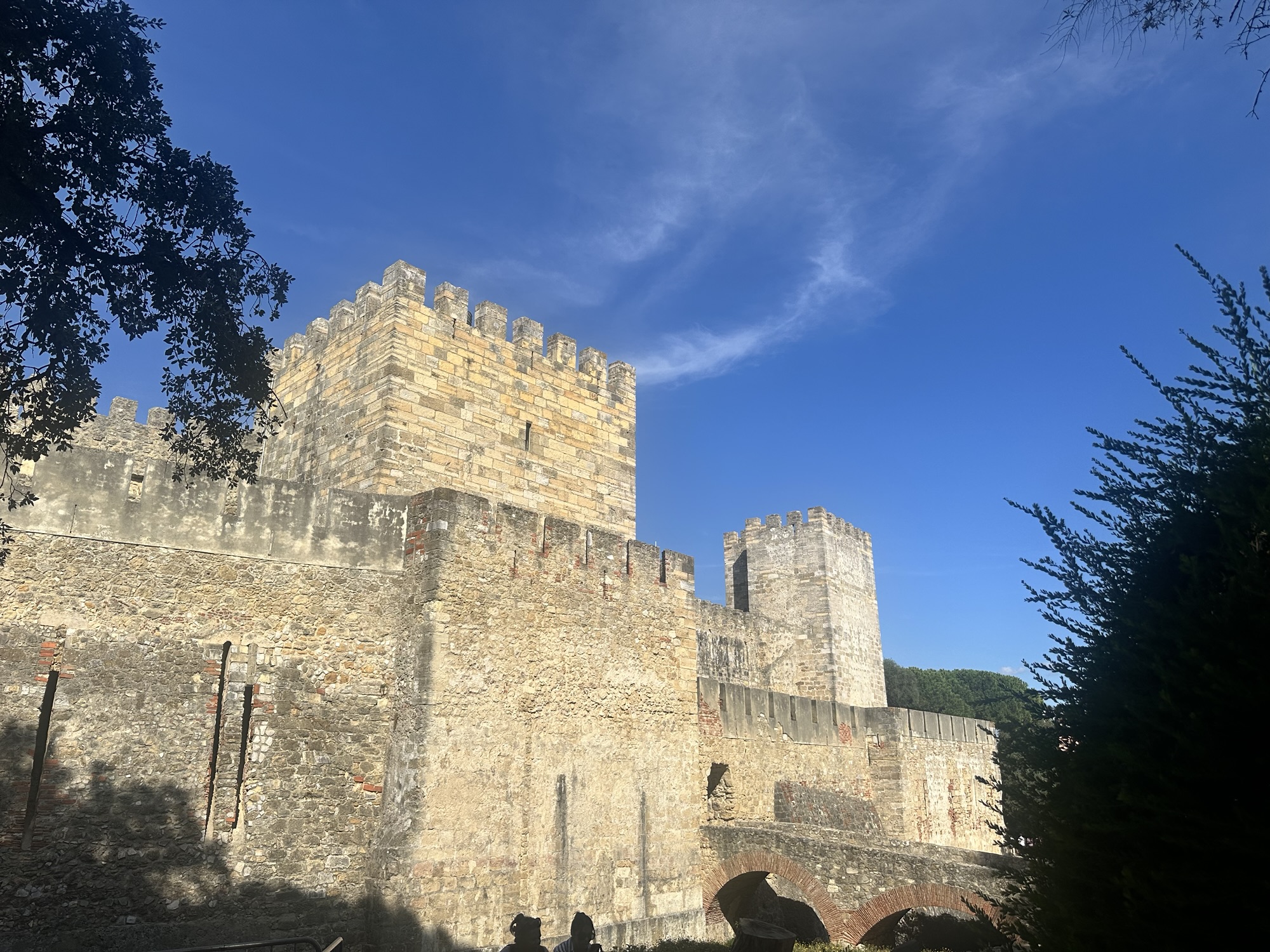
The last stop was Castelo de Sao Jorge, overlooking Lisbon from it’s highest point. The castle dates from the late 12th Century, but was used by the Moors during their occupation of Portugal and discoveries of Iron Age structures prove the site was used since at least the 7th century BC.
After a quick siesta, my phone & body were both recharged. I headed to the closest Metro station to activate my second 24-hour pass. I then went back to the surface and caught one of the old trolleys back to the place with hot stone steak. I arrived shortly after their 7 pm opening. Good thing too, as there was a line waiting for tables by 7:15.
The meal was very good, but not as good as the first time. I decided to go elsewhere for dessert so I could free up my table.
While looking for an interesting dessert place, I realized I was retracing the very first day of my Camino. Only this time it was dark and I knew where I was going.
I ended up going back to the hostel and asking for a recommendation. What they suggested, did not disappoint.
My bunk at the hostelView from the balconyThe famous #28 trollyPainting in the Quake museum of a church after the eventThe room where you read about the fire is heated with infrared lightsMap of downtown Lisbon before the Quake. Typical random narrow streets. After the Quake, the city core was rebuilt on a grid with standardized building dimensions with earthquake resistant elements View from Sao Jorge castle grounds. One of several peacocks roaming the castle groundsSao Jorge (St George)Guarding the cith from aboveObligatory selfieThe castle had a moat, but not a drawbridge. However there were three different vantage points above where invaders could be shot from An archeological dig on castle grounds has found evidence that the site has been used for nearly three thousand years Street performance with marionette. There is a puppet museum in town My dessert: Carmel & almond tart with decaf espresso
I’ve confirmed a key difference between a hostel and an alberge. Beyond the fact that Alberges are exclusively for pilgrims, there is a code of etiquette that you just don’t find at larger hostels in cities.
In the Albergue, we’re on a common quest, having walked long hours. Everyone goes to bed early and tries to be as quiet as possible in the common sleeping areas.
In my hostel last night, when I returned from dinner around 8:30, the light was out in my 8-person room and curtains were pulled across two of the lower bunks, likely indicating someone trying to sleep. I crawled into my bunk, pulled the curtains and – with AirPods- listened to the radio broadcast of the Ducks game (sad).
About 10pm, the room lights were flicked on, the hostel host brought in two more guests who proceeded to talk, rustle about and turn the lights on and off for the next 30 minutes. This would have NEVER happened in an Alberge.
Today I take the train back to where my trip started in Lisbon. After being flumoxed by public transit ticketing on my first visit, I’ve decided to purchase a 48-hour all-access card that works on trains, metro, busses, trolleys and funiculars (not currently running due to a fatal accident last month). The 48 hours works out perfectly for the time between when my train arrives on Lisbon today and when I can check into my near-airport hotel Tuesday afternoon.
The six-car train pulled into the station 15 minutes before departure. Several hundred people with luggage quickly boarded and we pulled out exactly on time. The train is very comfortable with tons of legroom, wifi and power ports.
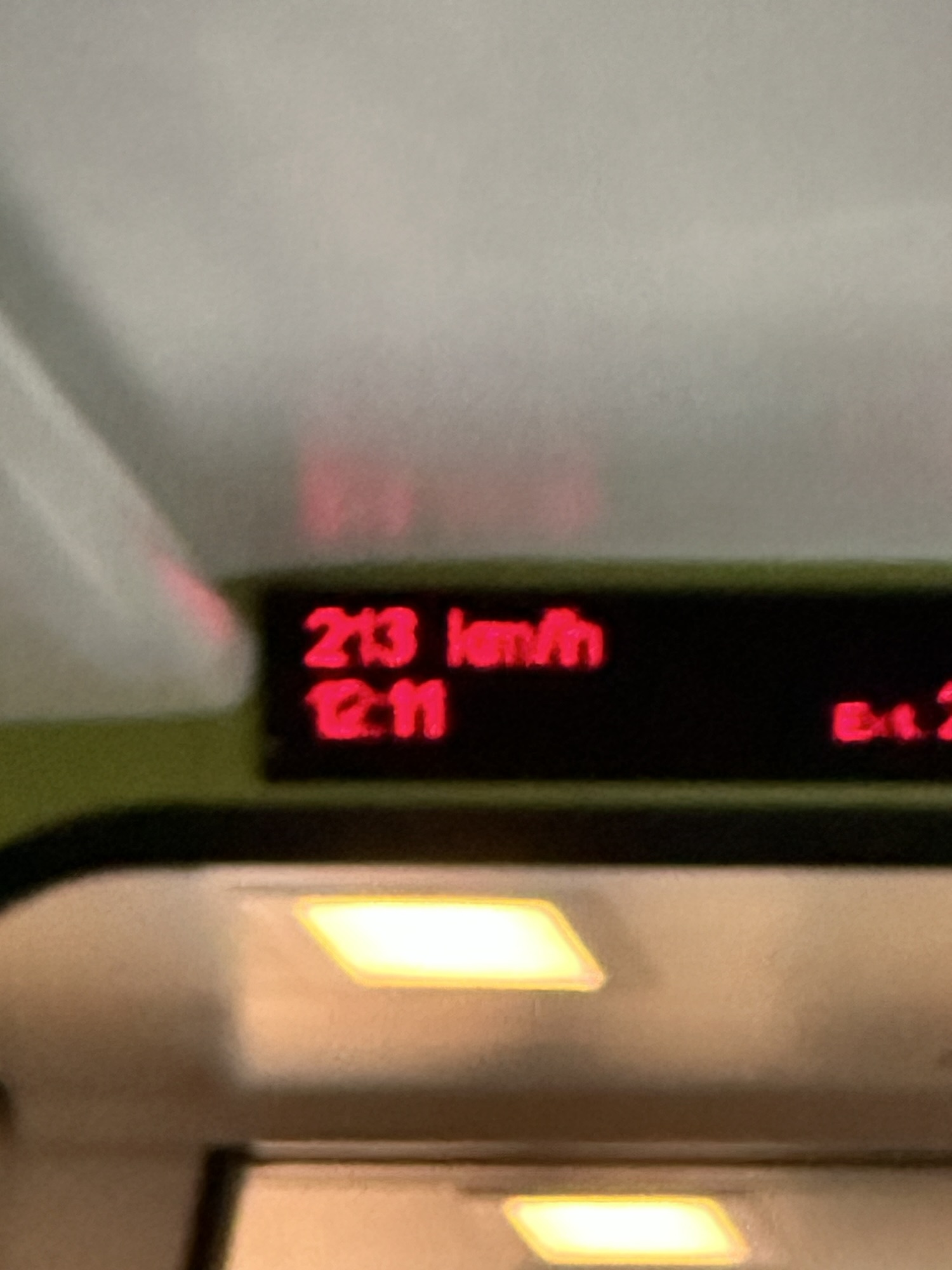
The overhead display shows the time, outside temperature and our speed – which has reached up to 218kmph (135mph).
I got into Lisbon and bought the 48-hour pass. I now feel like I have the keys to the city.
I took two different Metro subways to reach my hostel, which is just 150 meters from the nearest station. I dropped off my pack and walked a few blocks to the waterfront. I’m sitting in the beer garden of the Museu da Cerveja (Beer Muesum) watching a Euro Cup soccer match on the big screen. As soon as I finish my beer, I’m going to hop on the first tram that comes along and go explore the city.
Following my beer, I decided to just randomly hop on a ride and explore. I went to the nearest Metro station and hopped on a Azul Line train. A few stops up, I recognized a name from my first days in Lisbon.
I hopped off thinking I would be in the neighborhood I stayed in last month. To my surprise, when I got to the surface, I was inside a very modern shopping mall. I went outside the mall and realized my mistake. I had been here before, but this was the shopping district I went to looking for the sporting goods store when I needed to replace my pocket knife.
By this time, my phone battery was getting low, so I shut it off and decided to find my way back to the hostel just by using the transit maps. Two stops over on the Vermelha Line and five down the Verde and I emerged by the square in my neighborhood.
There was a craft fair going on in the square, so I wandered through the booths. I then bought a t-shirt so I could launder all the entire collection I had been wearing.
Walking back to my hostel, I encountered a film crew shooting a scene in a shop just across the street. I don’t know what is was for, but just judging by the amount of equipment and number a trucks, it was no small budget effort.
After getting a little charge on my phone, I headed out to dinner. I’ve so emersed myself in the local cuisine that I’ve been really ready for something lighter with more vegetables. I found a Vietnamese cafe and enjoyed a tasty meal.
Taken outside the Porto train station, you can do the construction boom. Look closely and you can see 10 construction cranes in the photo Ample leg room! Oh, I wish I had this much for the flight home!Simple, but tasty lunch at the train station. €3.80Map of the Lisbon Metro. My hostel is near where the green and blue lines converge in the Rossio neighborhood This dog is a doppelganger of Jessie’s dog, BunaBack at the square where my walking tour started last monthA beer museum!Served in insulated inverted bottle-shaped glasses
The hostel was very noisy last night. Snoring, creaking beds and floor boards. Getting out of the top bunk was not as bad as I feared, but I have requested a lower bunk for tonight.
I have an all-day tour today, so I packed everything up, abandoned my backpack in the 8-person sleeping room and left a note for the desk clerk. Hope it all works out.
I left the hostel around 6 this morning. Being near the train station, there were ample cafes open for an early breakfast. I’m so glad to be back in Portugal where a hearty breakfast can be had for €4.50.
I then walked through the dark, empty streets of Porto towards my tour pickup point next to the cathedral.
Our 30-person minibus uncludes wifi and charging ports. Our guide, Maria, explains that the Douro Valley was one of the first designated vinticultural regions in the world, first recognized in the 1750’s and designated as a UNESCO world heritage site in 2013.
Maria was very informative and on the drive to our first stop, we learned about the major industries of the Porto region: shoe manufacturing, cork, tourism and construction. We also learned that there is currently a housing shortage in Portugal mainly being driven by immigration from Brazil and the US.
Our first stop was in the city of Aramante. A beautiful town with a river through its center and a church and bridge both restored by a monk who was later sainted.
We then went through the Vino Verde wine region. Being between the ocean and the mountains and with a predominantly granite-based soil, it produces lighter wines.
We then went through the mountains in a tunnel nearly 6km long (3.5 miles) to emerge on the dry side of the mountains. With a mix of granite & shale-based soil and hotter, drier climate, grape vines have to work harder to produce fruit and the result are much bolder wines – perfect for Port.
Port is made by taking table wine and adding stronger alcohol (grapa or moonshine). This was done to stabilize wine for shipment to England when wars wars with France cut off the wine supply for the Brits.
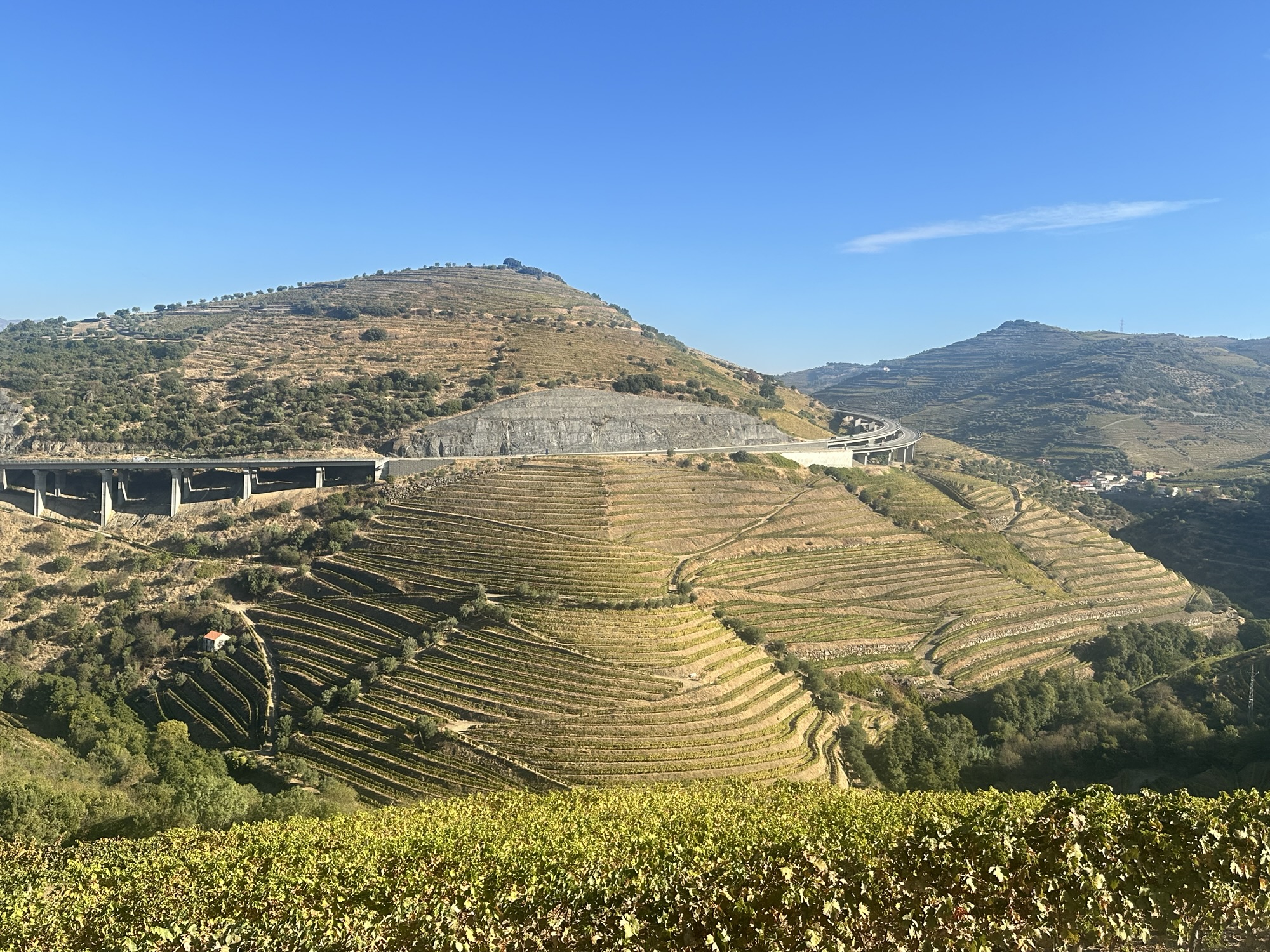
The Douro Valley has 250,000 acres of vineyards and it’s almost all in steep, terraced slopes that can only be picked by hand.
We visited a small winery for a tour and tasting, then went to lunch – near a viewpoint. We sat at one long table for 30. To my left, a couple from Boston. Across from them, two young women from Syria. Across from me a couple from Chicago who just moved to Lisbon. On my right, two young women from Manchester, UK.
Lunch was a creamed vegetable soup, cod cooked in cream sauce and cold vegetable medley. But the best part was the conversation.
On the way out, I saw a guy when the exact same pair of shoes. I stopped to talk with him and learned he was from Sacramento and was leaving from Porto on his Camino tomorrow.
Wine harvest used to be an all hands on deck effort with neighboring villages helping. These days, harvest relies on migrants from India, Nepal, Bangladesh & Morocco.
Our final stop for the day was in the town of Pinhao, which served as the shipping port for moving the barrels of port down the Douro on boats until a railroad was built in the late 1800’s. Now replicas of those boats are used to give tourists a river’s eye view of the valley.
Our way back to Porto started on N222 – “route 66 of Portugal.” Butto me, it reminded me of driving through the Columbia River gorge with a narrower river and much narrower road.
Reflection pond in AmarandePlaques show flood levels of four events over the past century I marvel at the effort needed to construct all these terracesThe bridge in the background was used to film the final scene in the most recent Fast & Furious movieOur tasting room View over the valley from 2000 foot vantage pointSmall chapel at the vantage pointI learned that cork is responsible for 5% of Portugal’s GDP. Besides wine stoppers, it’s used like leather hat clothing and accessories and in building materials Kayakers on the DouriWinery homes perched above the terracesExample of the tourist boat fleetFinal view of the terraced valley
Cookie Consent
We use cookies to improve your experience on our site. By using our site, you consent to cookies.
Contains information related to marketing campaigns of the user. These are shared with Google AdWords / Google Ads when the Google Ads and Google Analytics accounts are linked together.
90 days
__utma
ID used to identify users and sessions
2 years after last activity
__utmt
Used to monitor number of Google Analytics server requests
10 minutes
__utmb
Used to distinguish new sessions and visits. This cookie is set when the GA.js javascript library is loaded and there is no existing __utmb cookie. The cookie is updated every time data is sent to the Google Analytics server.
30 minutes after last activity
__utmc
Used only with old Urchin versions of Google Analytics and not with GA.js. Was used to distinguish between new sessions and visits at the end of a session.
End of session (browser)
__utmz
Contains information about the traffic source or campaign that directed user to the website. The cookie is set when the GA.js javascript is loaded and updated when data is sent to the Google Anaytics server
6 months after last activity
__utmv
Contains custom information set by the web developer via the _setCustomVar method in Google Analytics. This cookie is updated every time new data is sent to the Google Analytics server.
2 years after last activity
__utmx
Used to determine whether a user is included in an A / B or Multivariate test.
18 months
_ga
ID used to identify users
2 years
_gali
Used by Google Analytics to determine which links on a page are being clicked
30 seconds
_ga_
ID used to identify users
2 years
_gid
ID used to identify users for 24 hours after last activity
24 hours
_gat
Used to monitor number of Google Analytics server requests when using Google Tag Manager