Author: Greg H

  • Staying connected

    Staying connected

    Most of us travel with our cell phones these days.  But if you do not make a few adjustments to your normal cell phone use regime when traveling, you may be in for a shocking cell phone bill upon your return.  Fear not, there are a variety of strategies available to you that will keep you from having a heart attack when you see the roaming charges on your bill.

    The simplest and cheapest option is to simply turn off your cellular data option on your phone and not place any “phone calls” via your normal calling method.  Instead, rely exclusively on the availability of Wi-Fi and use an app like WhatsApp for your communications back home.  WhatsApp offers video, voice-only calling and texting over Wi-Fi.  I’ve used it extensively both when overseas and when communicating from home with friends and family in other countries.

    A word about using public Wi-Fi:  in most of my travels, I have found Wi-Fi readily available in hotels and restaurants as well as various public facilities.  I always make sure to have a VPN service enabled when using Wi-Fi as another layer of protection.

    The downside of relying exclusively on Wi-Fi is that if you are out and about, you may not have access to tools on your phone that are important while traveling (e.g. mapping tools; translation apps; etc.).  If you want to always be able to use your phone (assuming cellular coverage) you will need to make use of a data package.  Some folks purchase a ‘burner phone’ for the locality they are visiting and buy a SIM card with a small data plan.  This isn’t a bad option if you are staying in one country but can be more challenging if your travels involve multiple countries.

    You can check with your cellular carrier about international plans they may offer.  For example, I use T-mobile, and they offer a 30 day pass with 15GB of data and unlimited calling for $50.  For my 38 day trip, I’d also need to add on a 10-day pass (with 5GB) for $35.  So for $85, I would have passes to cover my entire trip and with 20 total GB of data.  Another option available to me with a Magenta plan is unlimited data and texting and calling at 25 cents per minute.  That works out to being even with the $85 option as long as I don’t make more than 9 minutes of calling per day.

    In my experience, the best option is to purchase an eSIM card.  This is a virtual SIM that lets you use local cellular providers.  These can be purchased online ahead of time and then activated when you reach your destination.  I use a company called alosim.  They offer a Western Europe card that works in Spain and Portugal.  I can purchase a 30 day/10GB card for $25.  Not knowing how much data I’ll be using, this option seems preferable to me, as if I find my utilization is higher, I can by another 10GB and still be in only $50.  If I need a smaller increment, I can get a 30 day/5GB sim for $15.
  • Trail Crew workout

    Trail Crew workout

    Not all my training is pure hiking.  On Thursday, July 17, I completed my fourth volunteer mission with Trailkeepers of Oregon as we worked to restore trails in the Columbia Gorge that have been closed since the devastating Eagle Creek Fire, which burned over 50,000 acres in 2017.  Eight years later, two key trails remain closed.

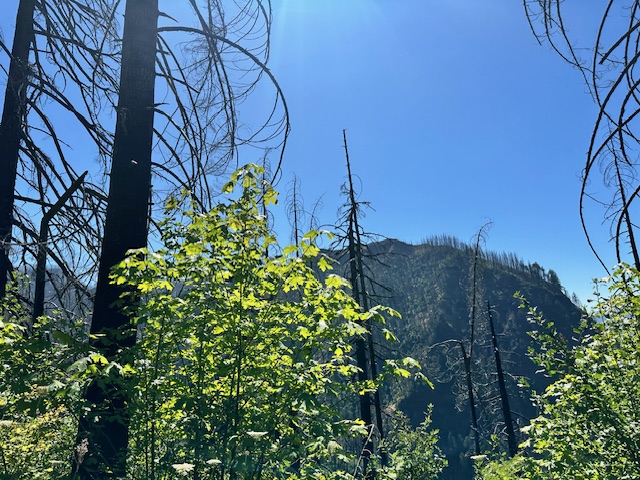
    Thursday, I joined a crew of seven working on the Tanner Butte Trail (Trail #410) which has all but disappeared as underbrush has covered the trail and grown tall.  On our crew last week, a couple of our team pushed their way through the underbrush for close to a mile marking where the trail should be with colored ribbon. 

    It was easy to see where our work from last week stopped, as we abruptly hit a wall of vegetation.  The photo below is the “before” shot of what the trail looked like before our efforts began.

    Somewhere in there is a trail.

    The work mainly consisted of using large lopping shears to take down the tall brush.  Then fire rakes were used to pull up some of the underbrush and expose where plants had taken root in the trail pathway.  Then it was work and hands and knees to clip the small brush (blackberry, Oregon grape and other viny plants) from the trail.  We also encountered two trees that had fallen across the trail.  As we had not planned for these, the largest saws we carried were 21” hand saws, which meant each tree (larger around than a telephone pole) took an hour or more for a two person team to cut a gap for the trail.

    After a hard day’s work, another few yards of trail have been cleared.

    After a full day’s work in the sun, we made about 100 yards of progress.  Just six more miles – and several more years – and this trail may be reopened.   I do want to stress that the trail remains closed to the public and the gate at the base is locked.  We were working under the authority of the US Forest Service, which allowed us to pass through the gate.

    If you love the outdoors, I encourage you to consider volunteering for a trail crew or making a monetary donation to help fund TKO’s work.  Cuts in federal funding have left a $500k gap in TKO’s budget for this year.  Any contribution of time or treasure is appreciated.

    One cool thing about our trail crew this time is that we had two women on vacation from New Hampshire who joined us.  They were touring Oregon for a week and one of them worked for a company that awarded extra PTO for doing volunteer work.  It was great meeting them and having them donate a day of their vacation to restoring this trail.

  • Sleeping gear

    Sleeping gear

    I feel like I have spent more time pondering and fretting over what to carry for sleeping than just about anything else.  My plan is to mostly sleep in alberges (special hostels just for pilgrims) and what is provided for you can vary dramatically.  On top of the variability of what is provided is the fact that I’ll likely be starting in hot weather in southern Portugal and finishing in cool autumn weather in northern Spain.

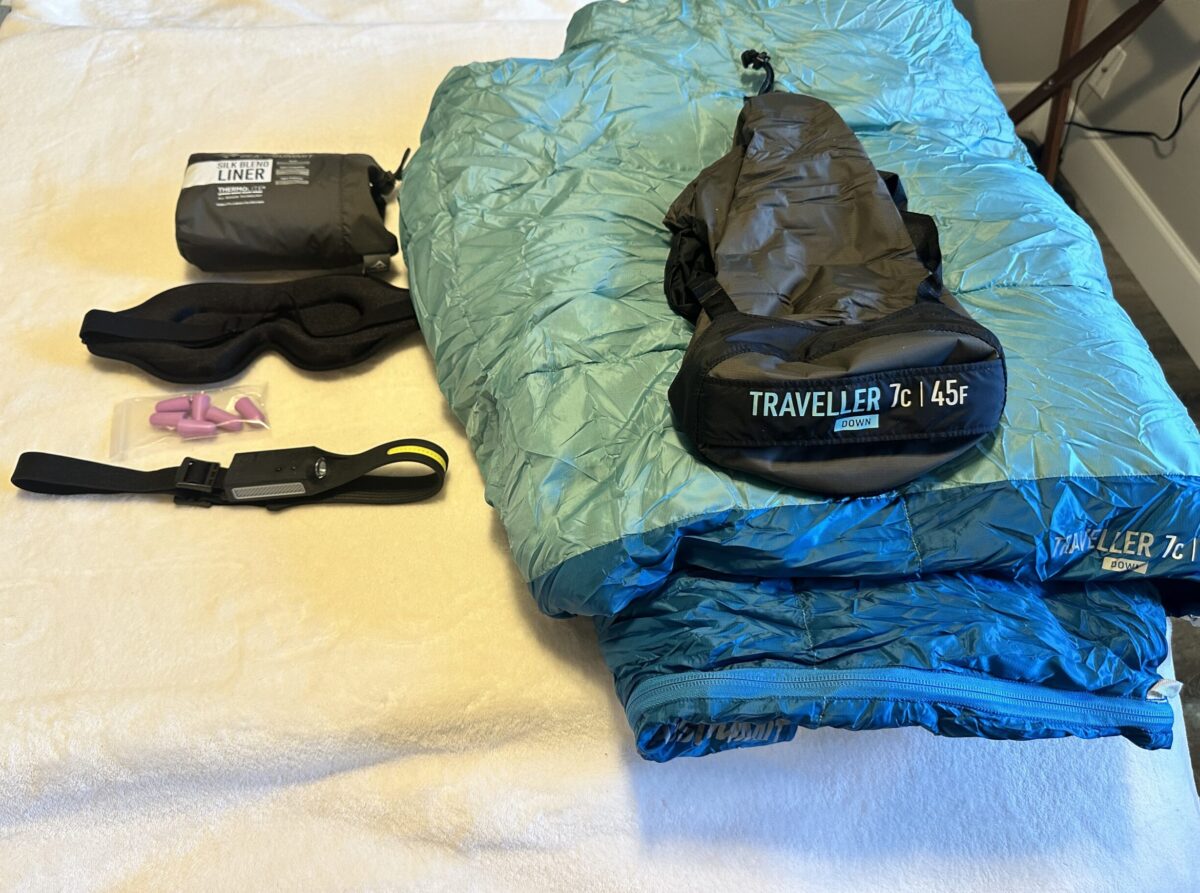
    After much consternation, I’ve decided to take both a silk sleeping bag liner for warmer nights and a lightweight sleeping bag for cooler evenings or when the alberge doesn’t provide blankets.  The sleeping bag liner is from Sea to Summit.  I opted for the rectangular option versus a mummy as I don’t like feeling bottled up at my feet.  It’s a silk blend which I chose because I have learned that bedbugs can’t penetrate a silk fabric.  Yes, bed bugs are a thing and I’m taking a variety of precautionary steps to avoid them (another blog topic). This liner is ultra-light at only 160 grams.

    My sleeping bag is also from Sea to Summit and is the Traveller 45F Down Bag/Blanket.  It’s not going to keep me warm if I go snow camping, but the 45 degree rating should take care of the most chilly nights I’ll encounter and I can add my liner inside of it for additional warmth if needed.  It will be the heaviest thing I carry (except the pack itself), but at 585 grams (1.29 pounds) it’s about as light as you can get for a sleeping bag.

    My sleeping gear is rounded out with a set of ear plugs and a sleeping mask.  Some of the alberges have rather large bunk rooms and these will help me sleep through the snoring and flashlights that might go on.  I will also have my headlamp as part of my sleeping equipment.  The headlamp features a red light setting so if I decide to leave in the morning before daylight, I won’t blind people as I round up my gear.

    All the sleeping gear fits into the compression sack for the sleeping bag

    All of these items fit neatly into the compression bag for the Traveller.  When compressed, all take up the space of a cylinder about 4 inches by 6 inches.

    Total Weight:826 g (1.8 lb)
    Total Weight in Pack:826 g (1.8 lb)

  • Electronics

    Electronics

    I would love to say that I am going to totally disconnect from the world for five weeks and travel without any electronics.  But that would be a lie.  While I know you could do that with the aid of a printed guidebook, I like the ability to track my daily distance, communicate with alberges in the town ahead and stay connected to family and friends.  So I will be traveling with limited electronics.  In my case, that includes my iPhone (15 Pro Max) and Apple Watch. To keep them charged, I’ll also have various methods of powering them in my electronics kit.

    Phone – while not the newest phone out there, I am very satisfied with my iPhone and its picture-taking abilities.  This means I don’t need to pack a single-purpose camera.  In a later post, I’ll dive into the must-have apps that will be of most use to me during my travels.

    Watch – I purchased an Apple Watch at the beginning of the year.  At the time, I was living by myself and my sister had recently fallen on her stairs and injured herself.  Fortunately, she had family in the home to take her to the ER for her broken ankle, but it got me thinking that having a device with fall detection would be a useful item for someone living alone.  This replaced a Fibit that adequately tracked my steps and other health metrics, but I really like the integration of the apps on my phone. 

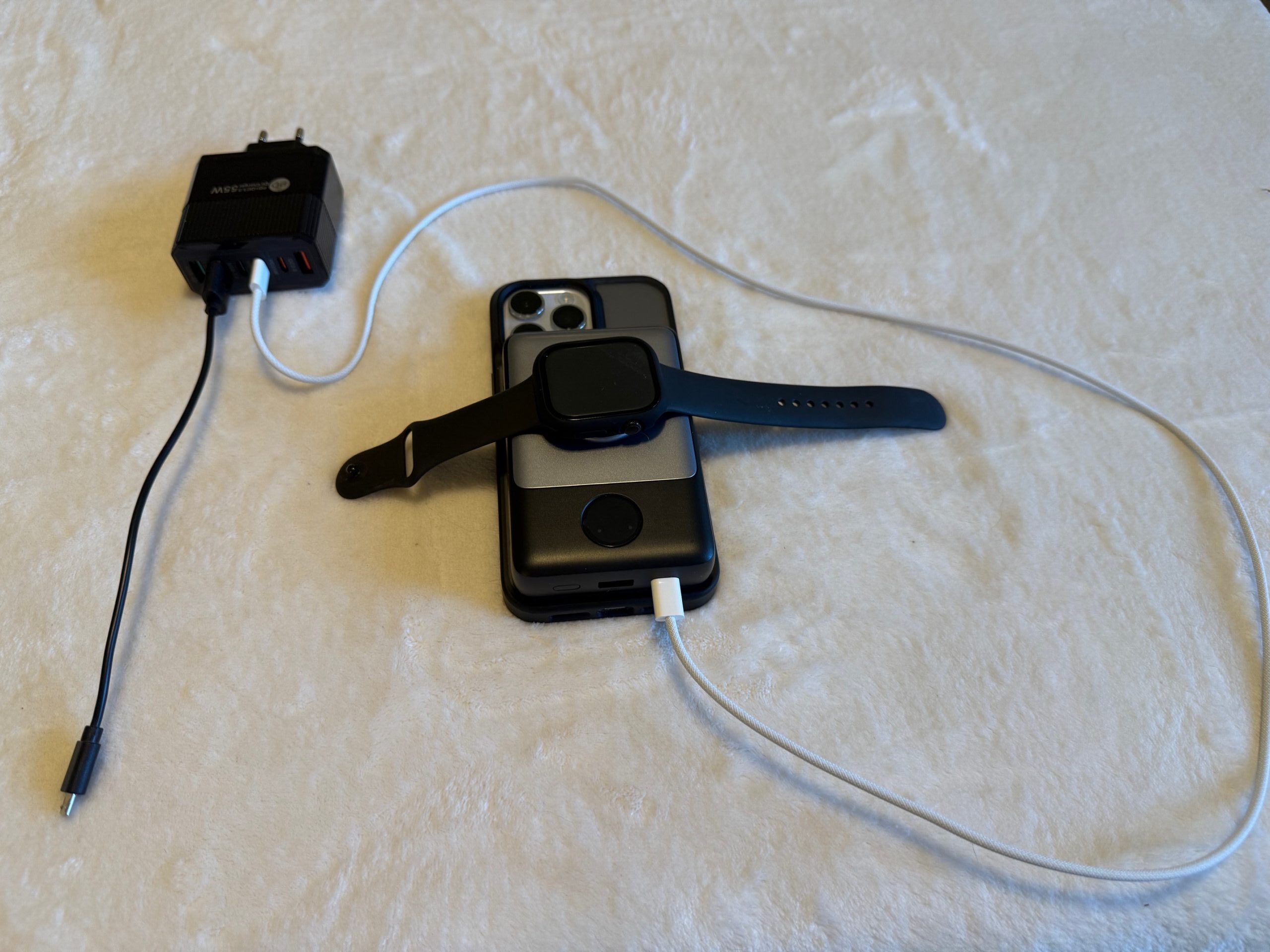
    Wall charger – the plan is to start each morning with a fully charged phone and watch.  But sometimes when you get to an alberge, the power outlets are limited and in high demand from others with the same objective.  My tactic is to get a European wall charger (2 round prongs) with six charging ports.  That gives me plenty for all of my needs plus 3 or more for others to utilize. So if all the outlets are in use, I can ask someone if I can plug in and then have their devices share my charger.  The charger includes three high speed USB C ports and three older USB A ports.

    Power bank – When hiking, if you are using a device to track your progress, it will be continually pinging GPS satellites and can drain your device in under 8 hours.  For this reason, I’ll be bringing a 10,000 Ma battery pack.  I’m still testing two different models.  One has a larger footprint but has the built in magnetic connectors for charging both my phone and watch.  It also has both a short USB-C and USB-A cord that pulls out from the side.  The other is more sleek, but requires me to carry more cables.  The combined weight of the pack plus cables make the two a push from a weight standpoint.  I will be testing the recharging time for each, as well as how much of its capacity it takes to recharge both phone and watch.  There will be another post diving into this in more detail.

    Cables – I will be taking a short USB-micro to USB-A cord no matter what. This will be how I recharge my headlamp as needed.  I’ll also need a USB-C to USB-C for charging my battery pack.  The two other potential cords would by my USB-C to Lightning for my phone and the proprietary charging cable for the watch.

    Total Weight:726 g (1.6 lb)
    Total Weight in Pack:160 g (5.6 oz)