Author: Greg H

  • Tea & Cake in the Middle of Nowhere

    Sunday, May 17 – We went to bed Saturday night with absolutely no idea of what we were doing the next day. But it ended up being one of the best days of my life and definitely of the trip so far.

    Our lodging Saturday did not include breakfast so the first decision of the day was where to eat. We headed towards our Sunday destination and stopped in the city of Tetbury for a fuel up of both car and human. Gas was £1.59 per liter. That works out to about $8.10 per gallon. $66 later, our half-empty Mazda fuel tank was full.

    Tetbury is the second largest city in the Cotswolds. Being Sunday morning, we had made reservations prior to leaving the hotel at one of the restaurants that seem to be open early. It was a cute café, and we both ordered eggs Royale think of eggs Benedict, but with smoked salmon instead of ham as the meat it was delicious!

    Eggs Royale – Yumm!

    We stopped at a store for a few picnic supplies and then drove on to North Nibley to start our hike. I’m not saying that North Nibley is a small town, but when the car gave us direction to turn onto The Street, you know if may not be very large.

    Pam had picked up a book of hikes around the Cotswald‘s earlier in our trip and we had selected one that started heading towards the Tyndale Monument atop a ridge just outside of town. William Tyndale, we learned, had been a local man who became the first to translate the New Testament into English in 1533. For his troubles and academic achievements, he was burned at the stake.

    The tower was open, so we decided to climb to the top. The staircase was extremely narrow and quite dark in some places. It really put Pam‘s claustrophobia to the test. But she was a trooper and made it to the top.

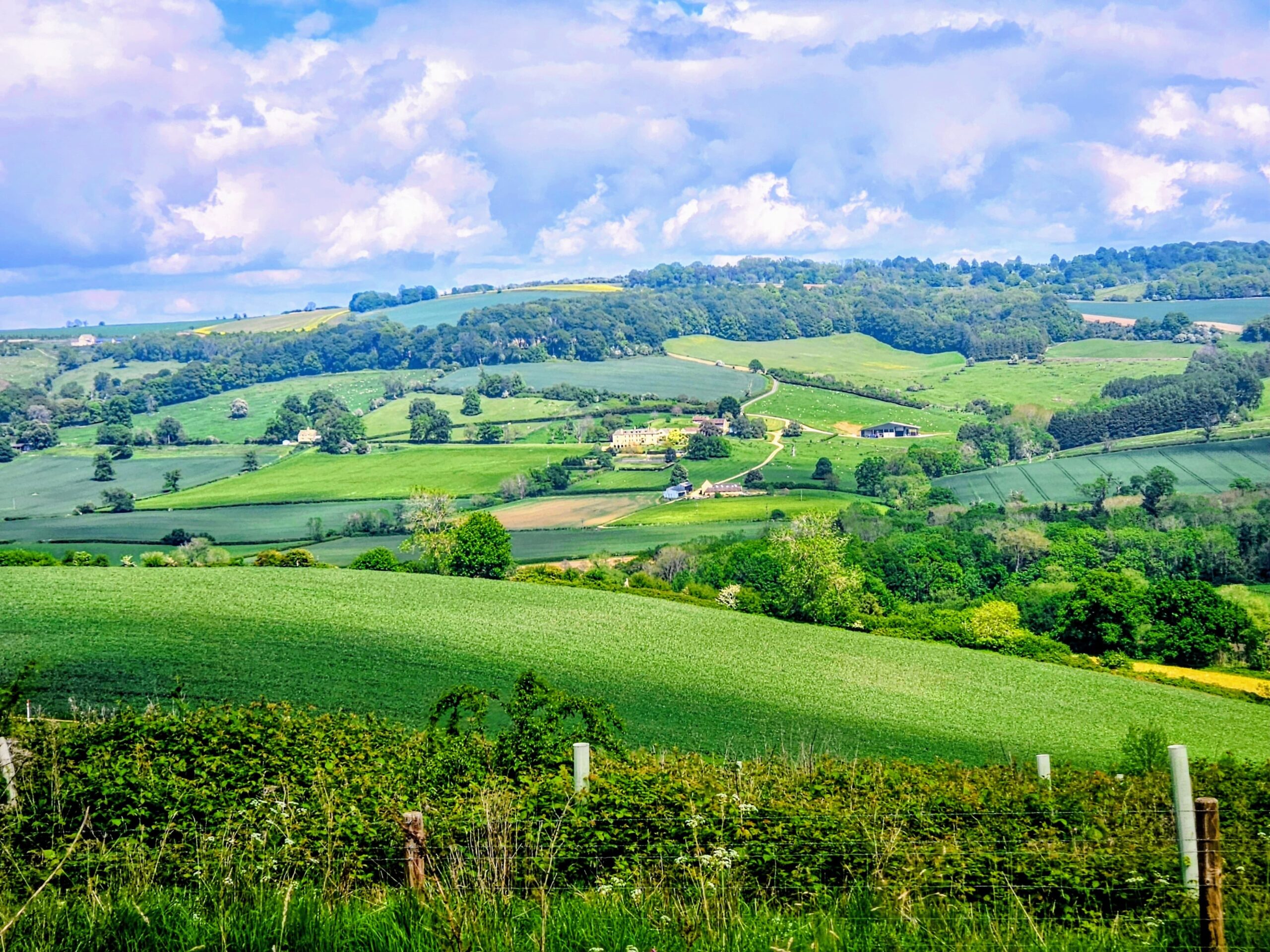
    The monument was located at the northern tip of an elevated area known as Nibley Knoll. The high ground was fairly significant and we spent a couple of miles hiking around the top of the knoll taking in stunning views. The far southern edge featured a grove of trees, surrounded by a stonewall with an edge that looked out over the town of Wooten under edge. There were several park benches and we decided this would be a good place for a picnic we read on a plaque that the trees were originally planted in 1815 to commemorate the victory at Waterloo over Napoleon.

    We descended the knoll on the south side and started through some woods as we began the return of our loop. We passed a couple of hikers going the opposite direction who informed us that just up ahead, a scout troop was selling tea and cake along the trail. It seemed a little odd, but sure enough a couple hundred yards down the trail we saw a tent and a bunch of people standing in a clearing. We emerged from the trail to be greeted by a group of friendly scouts. We purchased 2 cups of tea and shared a slice of homemade carrot cake. They even had chairs and tables with flowers on them. It was surreal and lovely.

    Tea and cake in the middle of nowhere

    After our refreshments, we got back on the trail and continued through the wood until the trail ended at a paved lane. We passed by several farms and were passed by several people riding on horseback out for a Sunday hack. After a mile or so, our path cut through a couple of meadows and we were suddenly back at our car, completing the 6-mile loop.

    We drove on to our Sunday night accomodation at the Devere Tortworth Court. While we had seen photos when we made reservations on Booking.com, we were not prepared for what we encountered. Starting with a gated entry nearly a mile from where navigation said we would end, we drove through an arboretum down a single-lane road. Suddenly, in front of was a massive grand estate which only photos can do justice.

    We learned that the estate was constructed by the 2nd Earl of Ducie, and finished in 1853. The estate passed through five generations until the 6th Earl had to sell the estate to a real estate developer in 1991. During WWII, while the 5th Earl was visiting his holdings in Australia, the estate was first used as a top secret training grounds for the Signals Corp of the British Navy, then as a US Army hospital.

    Shortly after being purchased, the manor was nearly destroyed by a devastating fire. The property was left derelict for 8 years. In 1999 a reconstruction effort was undertaken to restore it and turn it into a vacation resort.

    We spent our evening walking the grounds, admiring the century-old trees. We discovered the pet cemetery of the Ducie’s family animals.
  • Jumping ahead a few millennia

    Jumping ahead a few millennia

    Saturday, May 16 – After yesterday’s visit to a Neolithic burial site, we decided to jump ahead roughly 3000 years and visit some Roman ruins today. Our stay tonight is on the outskirts of Cirencester, which was originally called Corinium – which was the second largest Roman city in Britannia after Londoninium.

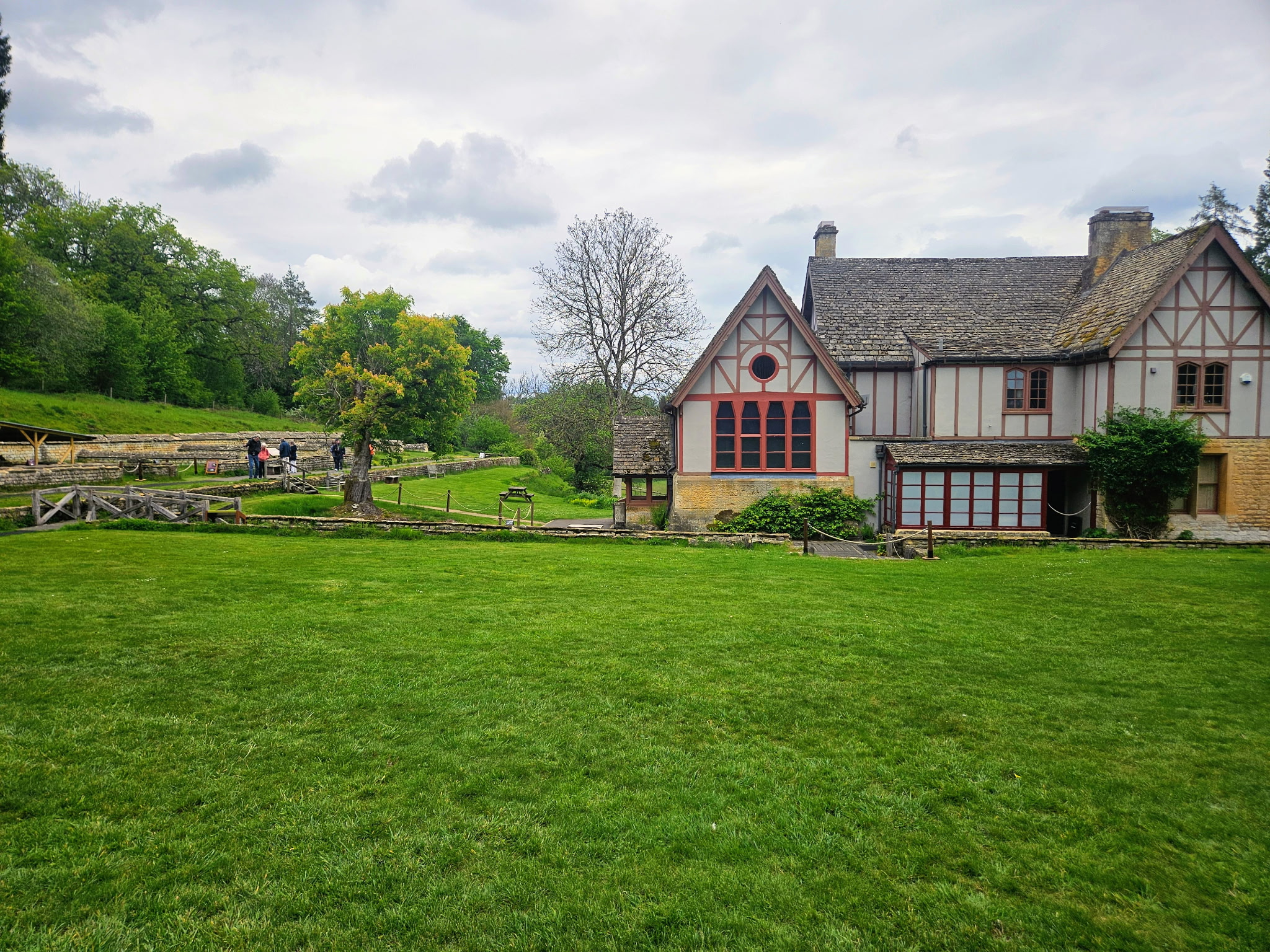
    On our way there, we stopped by the Chedworth Roman Villa, where in the 1860’s the ruins of a Roman country estate were uncovered. The site was really well preserved with amazing mossiac tile floors the foundations of buildings covering roughly an acre. I’ll use the photo captions to describe some of the facilities.

    After visiting the ruins, we drove into old town Cirencester. Pam wanted to do some shopping and I wanted to check out an open air market taking place near the cathedral. We agreed on a rendezvous time and place and went our separate ways to explore.

    We regrouped, we had a late lunch/early dinner at the Black Horse Pub and ventured down the road to our night’s lodging. After having spent the last four nights in hotels or pubs all at least 200 years old, the DeVere Costwold Water Park is a bit of a shock. With 388 rooms, it is massive. It’s also the first place we’ve stayed with elevators and card keys.

    The Cotswold Lakes are the result of a century of gravel mining on the Upper Thames. Beneath the gravel layer is an impervious layer of Oxford clay which results in the gravel pits quickly filling with water. Mining continues, but the area is vast (42 square miles) and over 180 lakes have been formed. Some are reserved for recreation while others are nature preserves. Our hotel sits on the shore of Lake 12. We took a walk around it and discovered the Thames-Severn Plough Road, which is an 18th century channel used to barge materials between these two major waterways of England.

  • Ancient burial grounds, folly & friends

    Ancient burial grounds, folly & friends

    Friday, May 15 – we left our charming Crown & Trumpet hotel around 8:30 in the morning. Apparently, there were no takers for an early breakfast this morning, as there was no staff at the Inn and we needed to use the skeleton key for the front door to let ourselves out.

    We found it curious that most places serving breakfast in town didn’t open until 10 am, but a walk through the downtown street found the Broadway Deli open and had a bite before hitting the road.

    First stop for the day was the Broadway Tower. Built in 1798-99, it was known as the”Brown’s Folly” atop the second tallest point in the Cotswolds. Throughout its history, it’s been a retreat for artists, a printing press, a lookout during both World Wars and has a nuclear bomb shelter constructed beneath. Since the 1980s, it has been privately owned by a family that know the only way to maintain the landmark is to charge admission and have it open to the public.

    The view from the top was stunning. You can see parts of 16 different counties from the Tower top. We enjoyed walking throughout the 200 acre grounds and watching the resident herd of red deer as well.

    After our Tower visit, we headed to the town of Winchcombe, which Pam declared had the narrowest streets she had ever driven on. If you encountered oncoming traffic, one party would need to yield and pull onto the curb to make room.

    We found a long term parking area and grabbed our rucksacks. Our destination was Belas Knap, a 5,500 year old Neolithic burial site atop Cleeve Hill – the highest point in the Cotswolds (1080 feet). The trek took us through several pastures, some of which were populated with sheep and their very young lambs. You definitely had to watch your step to avoid the slippery sheep dung on the very steep slope.

    The burial site was in a “long barrow” which was nearly 200 feet long and had several different burial chamber entrances. These included one that was the most obvious and most ornate, but what was actually a false entry to confuse and dissuade potential grave robbers.

    Pam stands at the entrance to one of the burial chambers where the skeletons of 14 humans were found,

    Our descent was more challenging than the climb, as the steep slope jammed our toes into our hiking shoes. When we finally got back to the car, I quickly shed my shoes in favor of some slides to give my poor toes some respite.

    Since reaching the Cotswolds, we have mostly been driving on secondary rural roads, but our path to our next destination of Birdlip took us into some more modern areas and we got to fight bumper-to-bumper traffic on our brief foray outside of the Cotswolds.. We were grateful to pull into the car park of the Royal George hotel and made our first stop be the lobby pub to help calm our nerves.

    We settled into our room upstairs and Pam took a hot bath to help relax muscles from the strenuous hike and nerve-wracking drive. We then went down to the dining room where we joined a former work colleague of mine, Steve Cook, and his wife and son. Steve and Madeline had come to England at tail end of son, Oakley’s semester studying at Bristol University. Oakley had just finished his last final exam that afternoon and we were able to help him celebrate the end of his semester abroad. It was great being able to rendezvous with friends during our trip.

  • Hike to the Slaughters

    Hike to the Slaughters

    Thursday, May 14 – Thursday was our second day in Broadway and we decided to see some of the neighboring villages. Using AllTrails, we found a 6-ish mile loop starting in Bourton-on-the-Water and then passing through Upper and Lower Slaughters (slaughters means “marsh”).

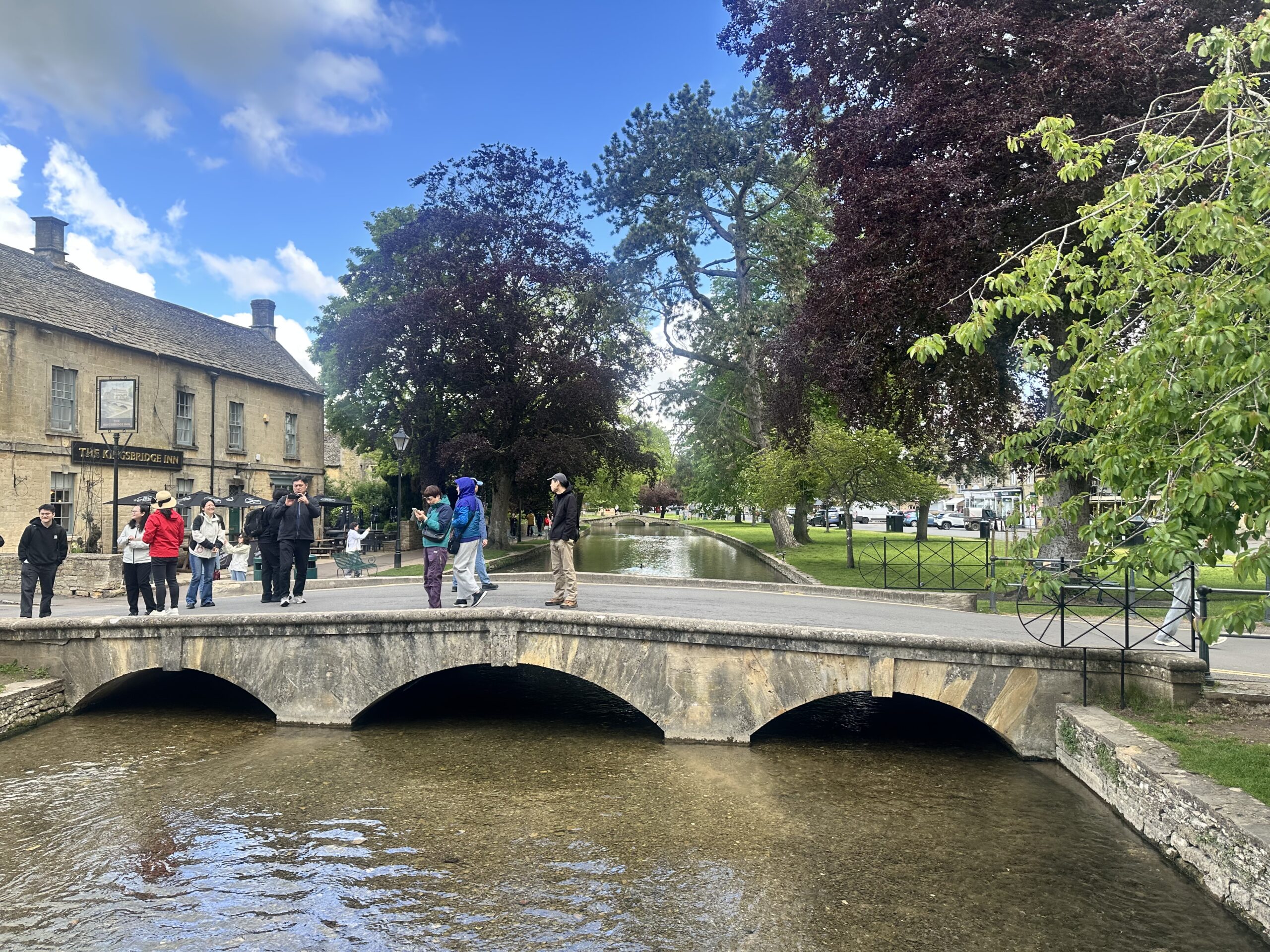
    Bourton calls itself “the Venice of the Cotswolds” as the lovely Windrush river flows gently throught the center of town. It is criss-crossed with many foot bridges and is a very popular tourist destination. We found a long term parking lot and strapped on our rucksacks and headed out along the river.

    As soon as we left the hubbub of the village, the sounds of birdsong overtook us. Using my Merlin App, I identified Eurasian Jackdaws, Common Wood Pigeons, Mallards, Eurasian Collared Doves, Dunnocks and European Greenfinches. Since arriving in England, I’ve added 12 new bird species to my life list in Merlin.

    Our trail veered away from the river and started through fields and pastures. The public rights of way through fields are amazing and the fun trick of trying to figure out the gate latch mechanism at each. We must have encountered at least different ones on this day alone.

    We dropped down a hill and entered into the tiny hamlet of Upper Slaughter. The River Eye meanders through the village of a couple dozen homes – half on each side. One road crosses a bridge, while another dips into the shallow river causing drivers and horses to ford the river. We found a park bench along the river and enjoyed some baked goods that we had purchased in Bourton.

    A Eurasian Robin wanted a handout while we were taking a break.

    Venturing on to Lower Slaughter, we find a nice hotel with a large outdoor dining area. We stopped for a pint and a short rest. After our refreshment, we continued back towards Bourton-on-the-Water. I missed a turn and we needed up passing an equestrian center that Pam visited two years ago. All of a sudden, she said “there’s Hans!” And sure enough, the Irish draft horse she had ridden in 2024 was in the pasture next to where we walked. It was a fortuitous detour.

    Hans seems to remember Pam

    We finished our loop back in Bourton and celebrated with an ice cream cone. Then it was back to Broadway to freshen up and then a nice dinner at The Swan, an inn down the road from our inn.

    We polished off the night with a brief stroll through downtown and back on a public footpath behind the downtown streets. We have loved discovering all the public footpaths in the area.