Author: Greg H

  • Financial considerations

    Financial considerations

    As much as we may not want to think about it, when it comes to travel, we always need to think about money.  A little planning ahead can save you headaches and potentially a lot of money in the long run.  This post is not exclusive to Camino hiking.  It applies to anyone traveling to another country and particularly when you are going for longer periods.

    Establishing a budget – It can be too easy to lose track of spending while on vacation.  Too many meals out, souvenirs, that unplanned spa visit…  Before you go, decide how much it will realistically cost for your vacation and decide if you can live within that amount.  I found AI to be a very helpful tool for this.  I created a prompt that I was a solo traveler planning to hike from Lisbon to Santiago. I gave my travel dates and my preference for staying in municipal alberges most nights with a few splurges in modest hotels in larger cities.  I asked it to include accommodations, meals and incidental expenses.  A few seconds later, it spit out daily average costs for each meal, price ranges for the alberges and modest hotels.  I made a few tweaks to the number of days I would spend in each type of accommodation and then built in a 20% contingency.  Now I have my budget. 

    Notifying financial institutions – Big brother is watching. And in this case, it’s not a bad thing.  If you live in Oregon – as I do – and your credit card suddenly starts having charges in another country, it’s quite possible those charges will be denied.  Save yourself some headache and contact your credit card companies before you leave.  They will need to know your dates of travel and the countries you intend to visit.  Don’t forget about any places you may have layovers in case you want to airport shop.

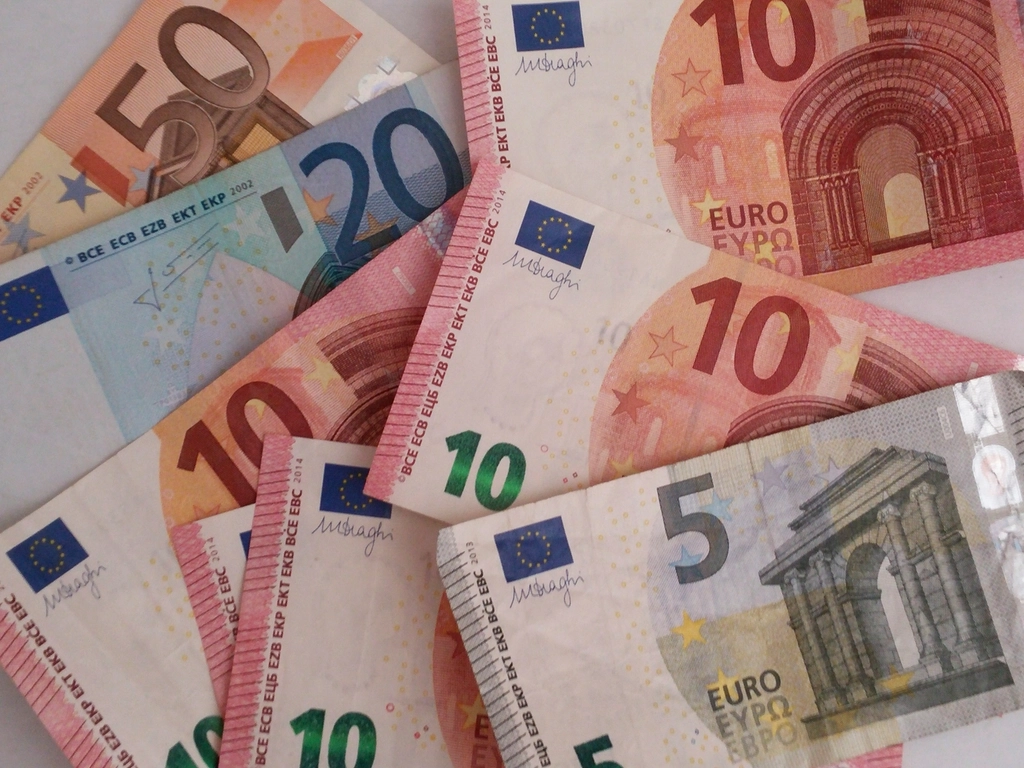
    Cash – Cash is still the preferred method of payment along the Portugues Camino.  Some alberges only accept cash and most smaller establishments at least have a strong preference for currency.  ATMs are common in cities and larger towns but be sure to have enough cash to get you through days traveling through smaller villages.  With the prevalence of ATMs, there is no need to be carrying large sums of cash at any time.  I intend to withdraw 200-300 Euro at a time and that should be ample for three to five days.  And like with my credit cards, I won’t keep all of it in one place.

    Credit cards – as mentioned previously, notify your credit card company before departure.  If you are the type that carries a small army of credit cards with you, consider putting yourself on a plastic diet for your trip.  My plan is to carry one primary credit card, with an emergency back-up hidden in my gear.  Be sure to check with your credit card companies about foreign transaction fees and their policy on exchange rates.  I use my Capital One Venture card as my primary travel card.  They don’t charge foreign transaction fees and have very competitive exchange rates.   

    Exchange Rates – Since the start of 2025, the value of the dollar against the Euro has dropped about 13 percent.  This means that that a trip that costs 3000 Euros would have cost $3,065 in January and today will cost $3,532.  Aside from having a crystal ball and being able to predict currency markets, the best I can do is grin and bare it.  And my plan is to convert to Euros now to avoid further erosion of the dollar. 

    My tool for doing this will be a bank card a French friend of mine mentioned called Revolut.  Revolut is a digital bank that allows you to transfer money from other banks and then provides currency exchanges at competitive rates.  I’ll then use their ATM card to withdrawn funds that I have already converted to Euros.  You can maintain multiple currencies within your Revolut account.  This would have been a very handy feature on my 2023 trip to three different SE Asian countries.

    US Dollar to Euro exchange rates over the past 5 years

    Paying bills – Since I will be gone for 38 days, I will be out of country for at least one billing cycle on every account I have.  To ensure I don’t return to past due notices or finance charges on credit cards, I am enabling automated payments on all my accounts.  I’ve already converted my utility accounts to charge to credit cards, so its mainly just making sure those credit cards are paid in full and on time.  I have previously enabled automatic payment of the minimum due – just to avoid getting a late charge due to forgetfulness – but before leaving I will change those settings to pay the full amount due.  I will also be scheduling transfers from my savings to checking account (which is where my bills are paid from) at regular intervals to make sure the account doesn’t run dry.  I also have low balance alerts enabled so if things do get out of whack, I’ll have some forewarning that I need to make some adjustments.

    Travel Insurance – The only people I have ever heard not say you should always purchase travel insurance are those whom have yet to experience a travel disaster.  Whether its losing your luggage or being injured while traveling, having insurance cost make a nightmare become just a minor bad dream.  For me personally, having insurance saved my family from financial disaster when my wife became seriously ill in Cambodia.  Between medical costs, an evacuation flight and reimbursement for the portion of our trip we were not able to complete, this insurance saved me close to $40,000.

    While you can purchase a free-standing travel insurance plan, often one is offered while booking your travel arrangements.  In my case, I booked my flight to Lisbon via Booking.com and was able to purchase insurance for $84 through XCover.com.  If I or a close family member becomes ill before I depart – it’s covered.  My coverage includes trip cancellation, interruption, travel delay, lost baggage, medical, medical evacuation and much more.  Pretty good piece of mind for less than a hundred bucks.

    Exercise caution – it should go without saying, but being cautious with your money and other valuables is an absolute must.  In my case, money, credit cards and my passport will never be away from my person.  I will carry these items in a fanny pack that will go with me into restrooms and shower stalls.  I won’t “flash cash” and will keep only enough money for a day in my front pocket.  The balance of what I have on me will be in an internal zippered pocket of the fanny pack.
  • Grooming kit

    Grooming kit

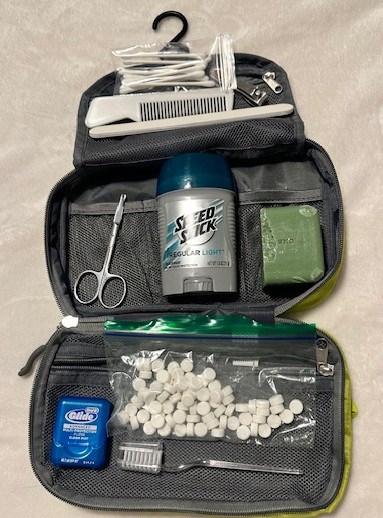
    To say my grooming kit is spartan would be an understatement.  I’m doing everything I can to not bring excessive packaging or more of a product than I expect to use. 

    Tooth care:  I am taking a super lightweight toothbrush I got as part of a travel kit on an airplane.  It weighs in at a whopping 7 grams.  In place of a tube of toothpaste, I will be using toothpaste tablets. With each use, you chew one and then brush.  This allows me to take exactly the number I need (and hope I don’t spill them).  I’ve also got a small, partially used container of floss.

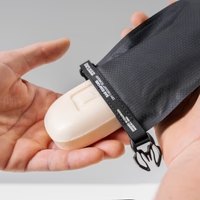
    For washing my body, I’m taking half a bar of eucalyptus soap.  I’ll use this on both my body and hair.  I saw a recommendation on using eucalyptus because it’s a natural repellent for bedbugs – and it smells nice too.  Once I start using the bar, I will store it in my Matador flatpack soap case.  This ingenious product has a fabric that allows the bar to dry without getting other things messy.  You attach it to the outside of your pack and the soap dries as you walk. 

    I’m also taking a travel-sized version of my deodorant, a comb (also from the airline grooming kit) and few Q-tips.  For keeping myself trimmed (notice no razor) I’ll have a small pair of scissors along and have nail clippers and an emery board for keeping my nails smooth.  While I don’t tend to get blisters, I have had occasions where a sharp toenail has done damage to its neighboring toe, so I want to be prepared to keep them in check.

  • First aid kit & blister prevention

    First aid kit & blister prevention

    With pharmacies available every few kilometers, I do not feel compelled to carry much in the way of first aid supplies.  I will, however, carry a small kit to hopefully prevent and deal with blisters should they occur. Hopefully, I’ll only need to administer aid to others and stay blister-free.

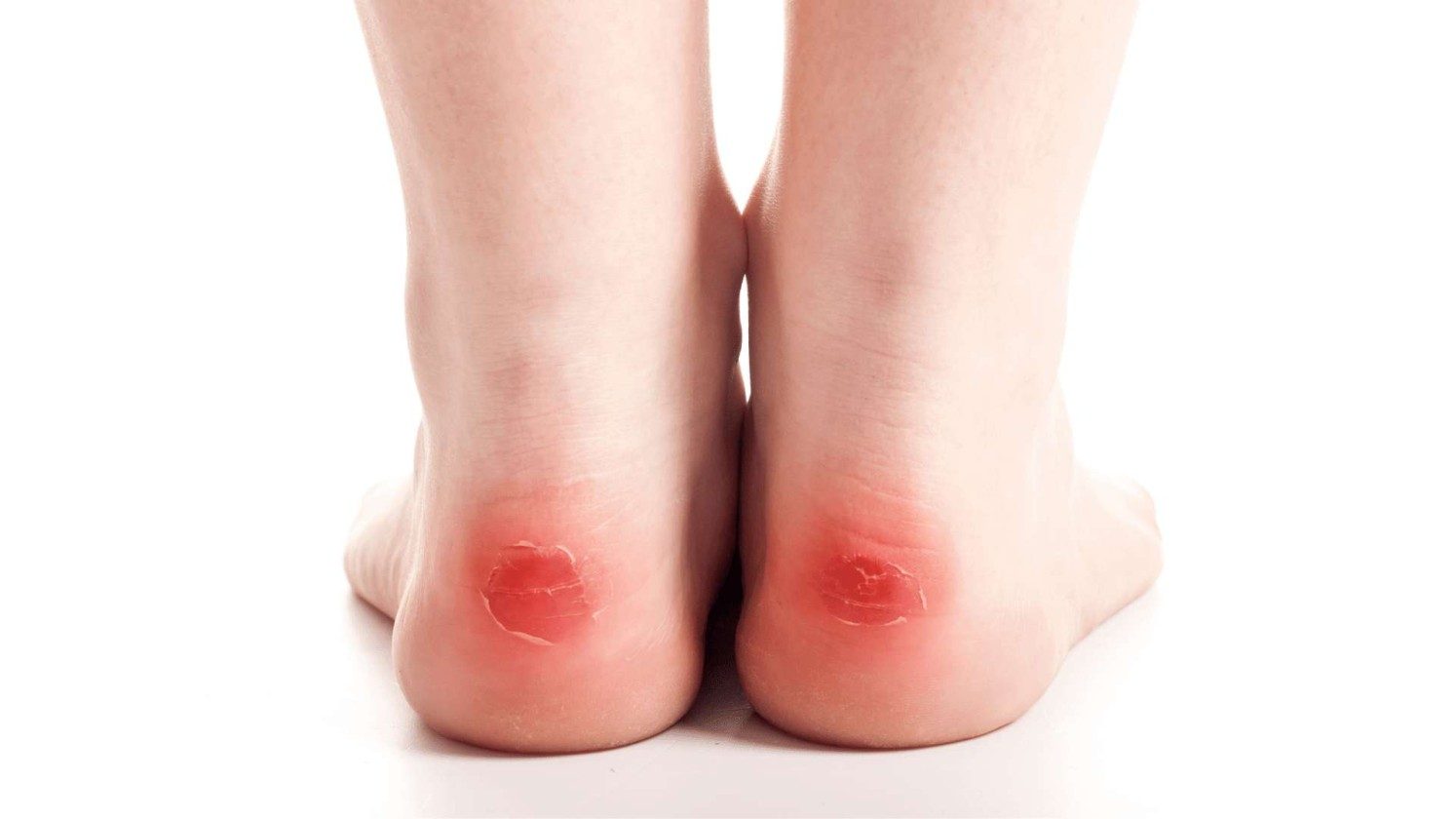
    Blisters are caused by friction. The friction can be from ill-fitting shoes (too big or too small) or due to moisture from sweat, rain or stepping in water.  The best way to avoid blisters are to have shoes that properly fit (and that you have trail proven before your big trip) and keeping your feet dry.

    Keeping feet dry involves a variety of strategies:  #1 – I’ve already posted about my choice of merino wool socks.  These wick away moisture and I’ve found that even after long periods of walking (10+ miles) my feet are dry.  Strategy #2 is to let your feet breath.  When I walk the Camino, I expect to stop every couple of hours for a refreshment break. At each break, I’ll take my shoes and socks off to allow my feet to air out.  Strategy #3 is to change socks if your feet do get wet.  Socks are the only thing I plan to carry more then one extra pair.  If my feet get wet, I’ll put on dry socks and hang the wet pair on the outside of my pack to dry.

    I don’t know if a blister is technically considered a second-degree burn, but like burns, before a blister appears, you will have a “hot spot” which is akin to a first degree burn with red, irritated skin.  If you experience a hot spot, you should stop and take immediate steps to prevent further irritation and head off the formation of a blister.  I’ve heard many strategies for this:  a blister patch, like Compeed; sock liners; medical tape; applying Vaseline; or my plan of using lamb’s wool

    If you do get a blister, the best advice is to leave it alone and let it heal.  But for many hikers, this isn’t considered an option because it will mean a delay (or even cancellation) of their hike.  For this reason, blisters are typically pierced with a sterile threaded needle.  The needle and thread are run through the bubble of the blister (without breaking the lower skin layer).  The thread is then clipped, leaving a bit of thread on each side of the bubble to allow any fluid to wick out. The area around the blister should be cleaned with an alcohol wipe or other disinfected.  Please note, that this process does introduce the potential for infection and should be used with caution.  If you notice any redness, inflammation, pain or colored fluid, seek medical attention.

    Mini sewing kit; band-aids; Compeed pads and alcohol wipes.

    So, the micro first aid supplies I will start with includes:

    • Alcohol prep pads
    • Sewing needle and thread
    • Band-aids
    • Compeed blister pads

    Total weight:  13 grams – including the Ziplock  baggie (less than one half ounce)

  • Staying connected

    Staying connected

    Most of us travel with our cell phones these days.  But if you do not make a few adjustments to your normal cell phone use regime when traveling, you may be in for a shocking cell phone bill upon your return.  Fear not, there are a variety of strategies available to you that will keep you from having a heart attack when you see the roaming charges on your bill.

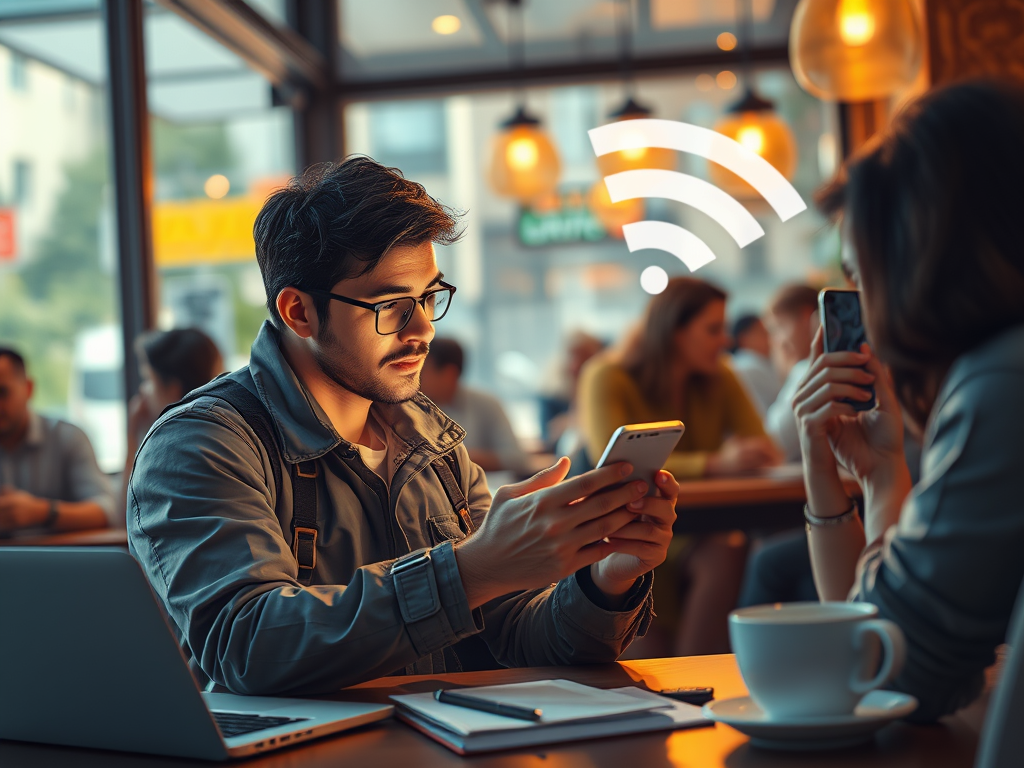
    The simplest and cheapest option is to simply turn off your cellular data option on your phone and not place any “phone calls” via your normal calling method.  Instead, rely exclusively on the availability of Wi-Fi and use an app like WhatsApp for your communications back home.  WhatsApp offers video, voice-only calling and texting over Wi-Fi.  I’ve used it extensively both when overseas and when communicating from home with friends and family in other countries.

    A word about using public Wi-Fi:  in most of my travels, I have found Wi-Fi readily available in hotels and restaurants as well as various public facilities.  I always make sure to have a VPN service enabled when using Wi-Fi as another layer of protection.

    The downside of relying exclusively on Wi-Fi is that if you are out and about, you may not have access to tools on your phone that are important while traveling (e.g. mapping tools; translation apps; etc.).  If you want to always be able to use your phone (assuming cellular coverage) you will need to make use of a data package.  Some folks purchase a ‘burner phone’ for the locality they are visiting and buy a SIM card with a small data plan.  This isn’t a bad option if you are staying in one country but can be more challenging if your travels involve multiple countries.

    You can check with your cellular carrier about international plans they may offer.  For example, I use T-mobile, and they offer a 30 day pass with 15GB of data and unlimited calling for $50.  For my 38 day trip, I’d also need to add on a 10-day pass (with 5GB) for $35.  So for $85, I would have passes to cover my entire trip and with 20 total GB of data.  Another option available to me with a Magenta plan is unlimited data and texting and calling at 25 cents per minute.  That works out to being even with the $85 option as long as I don’t make more than 9 minutes of calling per day.

    In my experience, the best option is to purchase an eSIM card.  This is a virtual SIM that lets you use local cellular providers.  These can be purchased online ahead of time and then activated when you reach your destination.  I use a company called alosim.  They offer a Western Europe card that works in Spain and Portugal.  I can purchase a 30 day/10GB card for $25.  Not knowing how much data I’ll be using, this option seems preferable to me, as if I find my utilization is higher, I can by another 10GB and still be in only $50.  If I need a smaller increment, I can get a 30 day/5GB sim for $15.