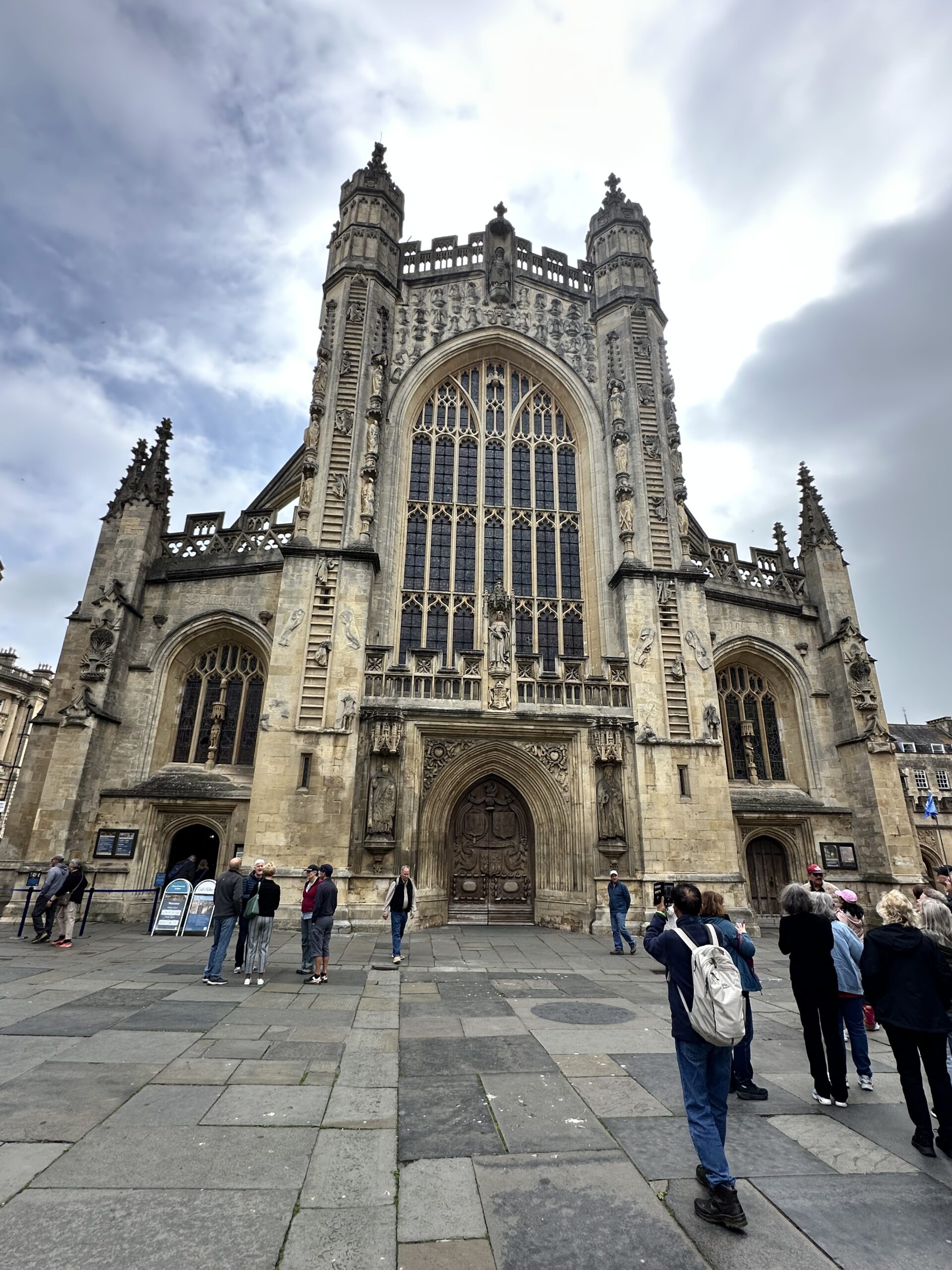
Thursday, May 21 – We said goodbye to our little shepherds hut and packed our car. Time to leave the Cotswolds and head to the coast. But first, we wanted to do a quick tour of Bath, a city immersed in history thanks in no small part to its mineral hot springs and their restorative powers,
The ancient Brits settled here after legend has it that the son of one of their kings was cured of leopresy from soaking in mud from one of the springs. When the Romans invading England, they established a city here in the first century AD.
We went on a 90 minute walking tour with a very entertaining local guide. We did not go into the Baths, as that part of the tour was an extra 27 pounds ($36) each for a 30 minute tour. Although much grander, we had seen Roman bath houses just a few days ago. Besides, we had a 3-hour road trip to get to our next destination.


I want to take a moment to commend Pam for her driving. Before we left home, she offered to drive, as this was her fourth trip to Engand and – as she said – being lefthanded makes her naturally want to drive on that side of the road.
While we have driven on a few freeways (refered to as motorways and designed with an “M”). Most of our time has been on much smaller roads. The equivalent to state highways back home are designated with an “A”, like A234. These typically (but not always) are two lanes with a painted white center divider. Smaller country roads have a “B” designation and often lack center lines and can be a tight squeeze when there is oncoming traffic.
And then their are the “lanes,” single-lane country roads with tall hedgerows or trees on both sides. The roads are pot-holed and you need to remember when the last “turnout” was so that if you do encounter another car, you know how far you may need to back up to make way. While at the Shepards hut, we needed to go down about three miles of lanes to get to our place. And the route for us to get from Bath to Lynmouth included a 7+ mile stretch of lanes. To say these roads are narrrow is being generous. Once, we had to back up into a turn-out to let a horse pass.
We had chosen a route that looked like it would take us along the coastline of Bristol Bay so that we could enjoy the view. Sadly, the hedgerows kept us from seeing any sign of the sea until we were just a couple miles from our destination. We were on a high ledge hundreds of feet above the water and then a sudden, steep downhill stretch dropped us into the quaint village of Lynmouth – so named because the river Lyn empited into the bay here.
We checked into the 7-room Bonnicott Hotel, perched on rock a ledge with a view of the sea and the sound of the rapids of the Lyn as our lulaby. After settling in, we decided to go explore and stretch our legs.
Between us and the sea is a small park along the waters edge. We walked down the driveway of the park and met two men in safety vests who told us there was a motorcylce gathering taking place in the park. They explained that they were “Blood Bikers,” an organization of volunteer riders who transport blood and other urgent medical supplies free of charge for the NHS during non-business hours – nights, weekends & holidays, 365 days a year. They invited us to join their festivities, but we decided to take their recommendation for the best Fish & Chips place instead.
The Espanade offered a choice of fried fish. Pam & I both got Cod and split an order of chips. We ate on a bench along the seawall, while baby Jackdaws squawcked for crumbs. After dinner, we walked down the rocky beach to the shore.
Lynmouth has a small harbor and when tide is out, the boats lay high and dry. We had walked by them at 7:45 and all the boats were grounded. Just an hour later, as we walked back, the tide had come in enough that all were floating again.
Our walk back to the hotel took us past a pub with a guitarist leading the crowd in sea ballads. We vowed to come back tomorrow night and join them.


